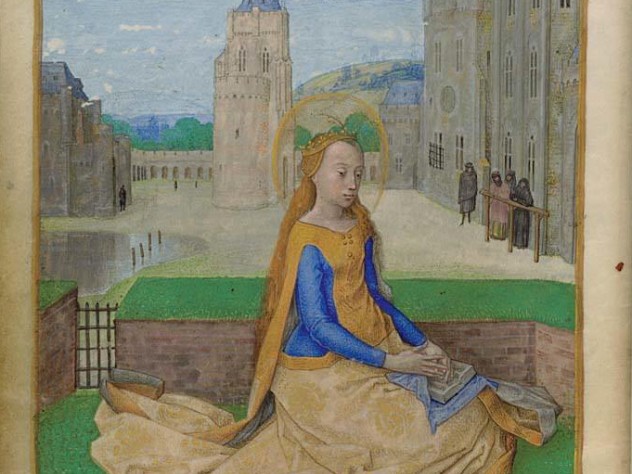
Saint Barbara, attributed to the “Ghent Associates” of the Master of Mary of Burgundy, from a book of hours-missal, c. 1485-1490. Courtesy of Houghton Library/Harvard University
We check in from time to time at magazines published by universities where we have recruited. This article, which we appreciate topically because of the conservation of cultural heritage described, makes us wish we could visit the venues described in “Illuminations.” Lily Scherlis provides a good example of why we keep coming back to this magazine–crisp, clear writing and a compelling argument in favor of looking back into history for an enriching perspective on crowdsourcing versus individual authorship (read to the end of the quoted section):
…These works were born into a world where literacy was scarce and almost universally affiliated with religion: the exhibition description refers to monasticism as, at its heart, a “cult of the book.” I imagine how compelling written religious text would have been to early readers: the words echo off the page, as if read by an invisible voice heard only by you, but are available to other readers as well. Continue reading
![Box 8. L'avocette de Buffon. Near Nantes, France, [1805 or 1806]. 1 drawing : pastel, graphite, and ink on paper ; 47 x 31 cm. Depicts the Avocet (Recurvirostra avosetta) standing on the ground with no background details. Unsigned. Audubon no. 117.](https://organikos.net/wp-content/uploads/2014/09/aubudon_buffon_605_1.jpg?w=676)
 Organikos