
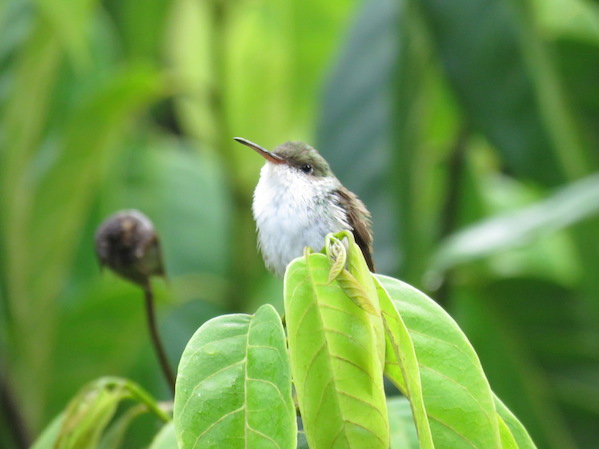
In the South American tropics, where hummingbirds must compete for food, evolution has drastically reshaped their bills. Credit Christian Irian
Hummingbirds are some of the most gemlike and visually striking birds in the “new world”, but those who have spent any time watching them know that striking can also be used as an apt verb to describe their behavior. Fiercely territorial, it’s not surprising that scientists are making more and more discoveries related to the evolution behind their development. (Click on image above to view the video)
The Hummingbird as Warrior: Evolution of a Fierce and Furious Beak
Winsomely captured in poems and song, the birds are yielding new secrets about their astounding beaks and penchant for violence.
If you want to know what makes hummingbirds tick, it’s best to avoid most poetry about them.
Bird-beam of the summer day,
— Whither on your sunny way?
Whither? Probably off to have a bloodcurdling fight, that’s whither.
John Vance Cheney wrote that verse, but let’s not point fingers. He has plenty of poetic company, all seduced by the color, beauty and teeny tininess of the hummingbird but failed to notice the ferocity burning in its rapidly beating heart.
The Aztecs weren’t fooled. Their god of war, Huitzilopochtli, was a hummingbird. The Aztecs loved war, and they loved the beauty of the birds as well. It seems they didn’t find any contradiction in the marriage of beauty and bloodthirsty aggression.
Scientists understood that aggression was a deep and pervasive part of hummingbird life. But they, too, have had their blind spots. The seemingly perfect match of nectar-bearing flowers to slender nectar-sipping beaks clearly showed that hummingbirds were shaped by co-evolution.
It seemed clear that, evolutionarily, plants were in charge. Their need for reliable pollinators produced flowers with a shape that demanded a long slender bill. Hummingbird evolution obliged.
But hummingbirds also heard the call of battle, which demanded a different evolutionary course. Some of those slender, delicate beaks have been reshaped into strong, sharp and dangerous weapons.
In a recent paper organizing and summing up 10 years of research, Alejandro Rico-Guevara and his colleagues at the University of California, Berkeley, shared evidence gathered by high-speed video about how the deadly beaks are deployed in male-to-male conflict.
Like the horns of bighorn sheep or the giant mandibles of stag beetles, hummingbird beaks are used to fight off rivals for mates. This is sexual selection, a narrow part of natural selection, in which the improvement of mating chances is the dominant force. Continue reading

 Organikos