Boca del Tule, Kayak & Surf

img_9395_zpsmfqybqon

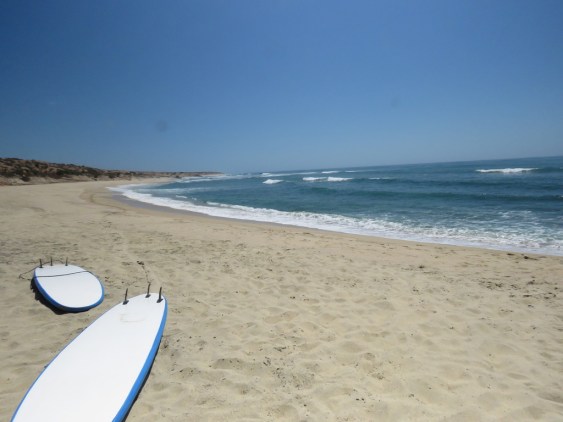
The shore down below Villa del Faro is known as Boca del Tule, since the Tule arroyo –– a seasonal river in the desert –– runs into the ocean at that point (boca means mouth in Spanish). The beach is public but very few people are ever on it, partly because we’re an hour away from the closest city, San José del Cabo, via dirt road. Now and then you’ll see a couple fishermen, or if the waves are good, some surfers. Last week, Jocelyn and I tried surfing both here at Boca del Tule and also at a better-known surfing beach just twenty minutes south called Nine Palms.

Both spots offered fair surfing for either experienced or newbie surfers, since Continue reading

Sweet NicarAgua

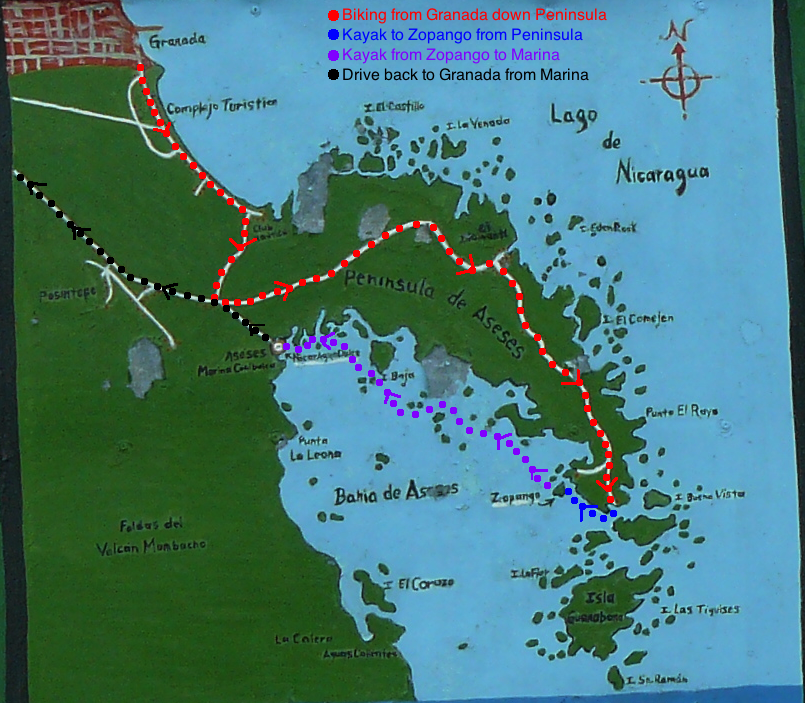
This morning Pierre and I went on a trip facilitated by Mombotours, using Detour bikes and NicarAgua Dulce kayaks. Eddy, our guide from Mombotour, arrived after breakfast and drove us to Detour, the bike rental shop. We picked up three bikes and left Granada’s hub towards the shore of Lake Cocibolca. The Mombotour driver followed behind in the truck in case we had any bike problems or accidents. We hadn’t gone more than two or three kilometers when the truck’s presence became needed. I’d accidentally driven over some glass, and punctured my tire in two places with tiny shards. With the tools and spare tube in the truck we were able to fix this unfortunate damage within twenty minutes, and Eddy’s training made my negligible REI workshop experience unnecessary.

The rest of the bike trip, which lasted about an hour and a half, was without further perforations, and we enjoyed riding up and down muddy dirt roads, dodging stones and chickens along the way. The mountain bikes performed very well and changed gears fluidly, which is always a nice surprise. We rode down along a peninsula till Continue reading

Kayak Surfing with a Friend

Today I met Pierre de Chabannes, a young Frenchman interning at the Ponçon’s La Cumplida farm in Matagalpa. A student at a French University, he is working on repairing and improving the current hydroelectric dam/canal system in place at La Cumplida so that the farm can produce enough electricity to supply the surrounding area in Matagalpa.

After showing Pierre around the ecolodge, we decided to go kayaking in the cove. We went out past Morgan’s Rock and then crossed over to the other side of the cove before returning to the coast, where we caught a wave onto shore and tried surfing a couple times. Eager to surf some more, Pierre switched his seat to the back of the kayak (we’d had them in the middle), where he thought it would allow him to control the direction better, as well as prevent the nose of the kayak from plunging into the water and causing a flip (which had happened to both of us already). Controlling the direction was also useful because we had both been pushed parallel to the wave we were riding several times despite out best efforts. When he switched to the back seat, Pierre surfed all the way to shore with little difficulty, so I soon made the same change. Continue reading

Sea Kayaking

Yesterday afternoon Harvey and I tried kayaking around the cove. Since the waters were very calm once we got past the waves, we decided to also paddle out of the cove and even past the literal Morgan’s Rock, a jagged tooth of rock sprouting from the ocean with a couple tufts of grass growing on it here and there. The Rock is actually part of the neighboring cove even though it doesn’t look it from the Ocotal beach (the ecolodge’s). We sat around for several minutes at a time, just feeling the waves lift and lower us on the water. It is an eerie feeling when you are so low in the kayak that you watch a swell block out the horizon and rise above your head, only to carry you up set you back down as it passes you, not truly a wave until it reaches the beach. Even with these peaceful pauses, the speed with which we were able to reach the rock told me that reaching San Juan del Sur by kayak within four hours was easily possible. After making sure that the next day’s weather would be safe, I made plans to set out early in the morning for SJdS with a fishing boat, the Eco I, as an escort.

*

Today I left the beach at around 6:50AM. It was high tide, and there were many small waves crashing onto the shore and my kayak as I tried to make my way over to the fishing boat anchored a couple hundred meters out. Once I was properly soaked, I got past the waves and greeted the two fishermen, Jacinto and Alejandro, passing them my backpack after removing my large water bottle and sunglasses. Jacinto checked his phone—it was 7:00AM, time to start. I shoved off the Eco I and started paddling.

The monotony of the trip was broken by scenery and “visits” by animals. A needlefish jumped out of the water a couple yards in front of me; frigate birds would start a dive towards the water and suddenly pull up, their prey apparently swimming for cover; over a dozen butterflies (not all at once) fluttered wildly over the waves of the open ocean–a comical sight. I couldn’t help thinking that if I was only a few miles further off shore, I may attract dolphins. However, despite my motored escort boat I didn’t feel safe kayaking out that far, and my job was to determine the duration of a trip to any of the coves south of Morgan’s Rock. Throughout the trip the coastline was a comforting danger—I could easily see the waves crashing violently into the many rocks protecting the shore, so I always maintained my distance from the coast even though there may be less wind to slow my voyage.

Huge rock formations and green forests provided most of the interesting landscape, although I also passed the well-known surfing beach, Maderas (which I will save more details on for a future post) and the Survivor filming site Playa El Toro. While in the open ocean I took two or three breaks of about a minute each to drink some water and stretch my fingers and shoulders, as well as to rearrange the Buff I had put on my left shoulder to block some of the harsh rays poking through the clouds (one of which, by the way, looked stunningly similar to a hummingbird’s head, with eye detail and everything). Once I entered the San Juan del Sur bay, passing the immense US Navy Hospital Ship on my right, the wind picked up to the point that I had to take several more breaks to loosen my shoulders. I had no idea how long I’d been kayaking, but I was ready to ride a wave onto shore and use my legs for a change. When I was a couple hundred meters from the beach, the fishing boat pulled up behind me and dropped anchor. I went ashore and bought the fishermen and myself a drink and some snacks, then kayaked back to the Eco I and tied my craft to the larger one. From leaving the Eco I at Morgan’s Rock to returning to it from the San Juan del Sur shore, the trip had taken two and a half hours.

Our ride back was much more relaxing, and I asked Jacinto questions about potential and current ocean excursion offerings while Alejandro fished and made a comment every now and then. One fun activity that Jacinto mentioned is diving with an air-hose the way it used to be done with huge brass helmets (except now one simply uses a mouthpiece), so I plan on trying that out as soon as possible.

Kayaking in the sea brought back memories of the last time I had a paddle in my hands: while exploring the blue caves in the cliffs of Koločep, an island off the coast of Dubrovnik, Croatia. Although the Adriatic Sea is radically different from the Pacific Ocean, my arm muscles certainly thought the same of the two experiences.
The Estuary Part Two: Update

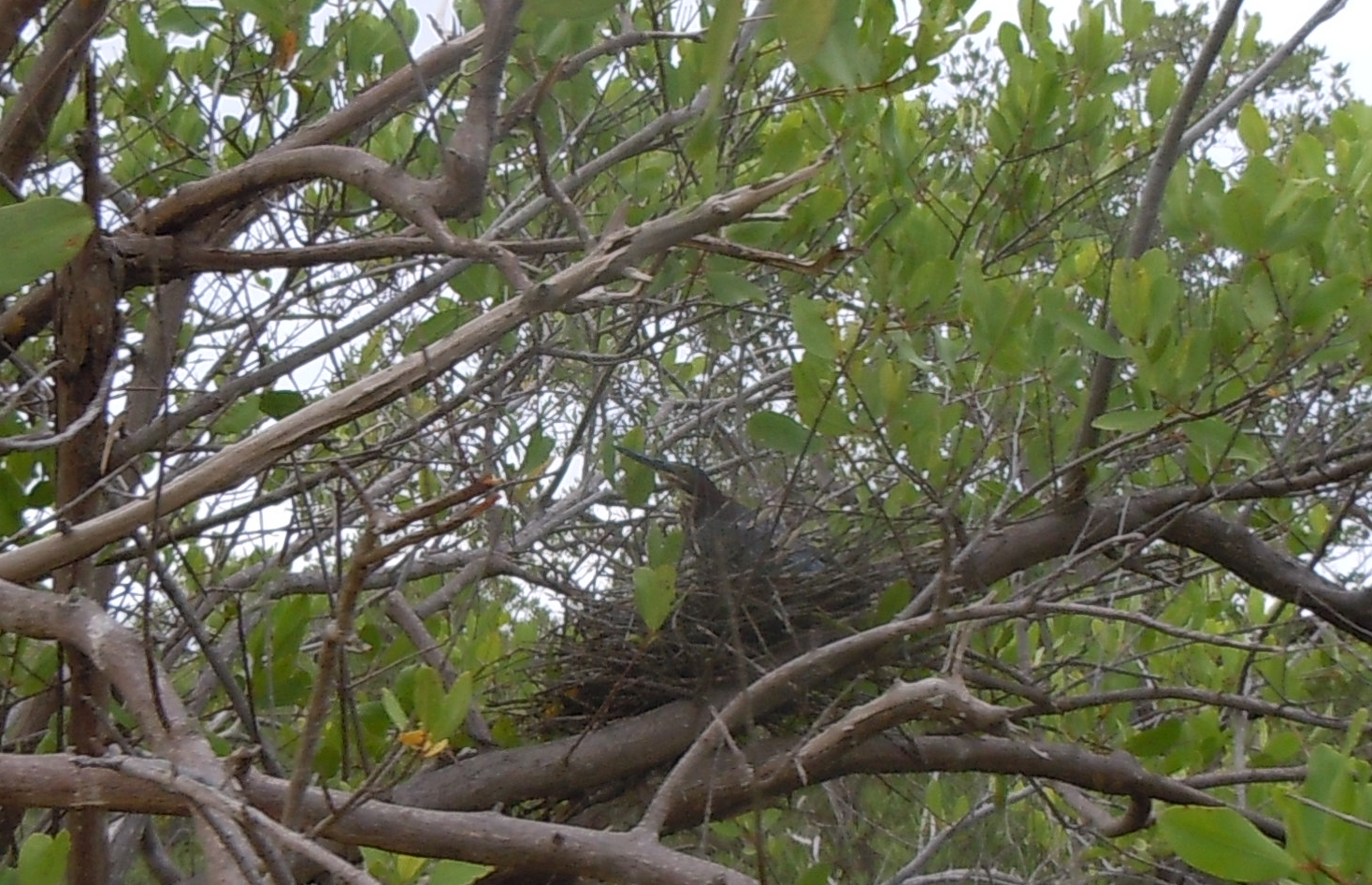
*The nested bird in my last post was a Green-backed Heron, and the woodpeckers were Lineated Woodpeckers. Other birds I’ve encountered are Great Blue Herons, White-tipped Doves, Muscovy Ducks, several hummingbirds and kingfishers, and more.

My kayak trip was the same as usual, with constant bird sightings and several howler monkeys in the trees above me. What changed was the end of the excursion. I decided to try kayaking down the stream of estuary water flowing into the ocean and see if I couldn’t catch a few waves close to shore before calling it a day. The stream of water was fairly shallow, with little piles of sand causing tiny swells of the sort seen over rocks in whitewater rivers. I had fun navigating these “water-bumps” and eventually made it into the ocean after a bit of shimmying past the shallower spots where I got grounded. I immediately set to getting past the already-broken waves so that I could catch one as it rose, like one does while boogie boarding or surfing. After getting buffeted around a bit by the incoming waves, I managed to turn the kayak around just in time to catch a small wave back to shore, paddling as I neared the sand so that momentum would carry me up the beach. Delighted by these first results, I continued to attempt kayak surfing for the next fifteen minutes before it got dark. Once it did, I dragged my kayak in and looked forward to doing the same the next day.

However, the estuary was a completely different place the next day. Very much open to the ocean, the mangrove sanctuary was continuously losing water. Slightly wary, I entered my kayak and paddled forwards. At first, the differences I noticed didn’t seem too grave: the water was shallower, but also very clear – I could actually see the bottom at some points. As I continued into deeper waters, the water darkened again but stayed quite shallow at some points. Once I got to the open area with the mangrove trees dotted around, I was able to distinctly see the effects of an estuary at a different point in its cycle: the mangrove trees had water-markings on them showing that the water levels had descended well over a foot. Here are some before-and-after shots: Black mangrove tree with distinct water markings, and branch before and after.

To read more about estuaries and their cycles, you can visit the National Oceanic and Atmospheric Administration’s educational tutorial. Follow the links on the right-hand column to learn about their importance ecosystem services and more.


The Estuary Part One

The estuary waters are always flat and calm, with practically no current apart from what the wind kicks up, and the OceanKayaks’ sensitivity to motion allows you to maneuver very adeptly around mangrove trees or floating logs. All the kayaks are doubles, but I have only gone out alone in the back, and later the middle, seats, joined either by Harvey in another kayak or by the winged microfauna (who tag along even when Harvey is keeping me company).

The estuary runs for over a kilometer and a half in a winding path, but there is also a larger open area with mangrove trees dotted inside it. The trees in this wide space are lower and farther apart, allowing you to get up close to the tree and check out the birds’ nests within. A couple times I have been able to see birds sitting in the nests up close, and it is fun to test how slowly you can approach them without scaring them away.

Paddling the estuary is a great activity because you can choose your pace very easily. If you want to take two strokes and then slowly glide along for a minute while looking for birds in the trees, then you can do so, as long as you make sure not to drift too far to one side and bump into a mangrove. If it is already getting dark and the mosquitoes are taking advantage of this fact, then you can see how much of a wake you can leave as you speed towards the beach and watch fish jump out of the water to get out of your way. I generally use the slow and photograph-friendly method on the way in to the estuary, where I can get shots of caterpillars or woodpeckers, and reserve the faster cardio-workout for the way back. I have been thinking about taking a kayak out onto the cove, where the waters seem pretty calm once you get past the first couple waves. I’ve never been on a sit-on-top kayak in the ocean before, so I’ll let you know how that goes.