 I just learned of an urban tree-planting initiative on a day when the news shows purposeful indifference about climate change on the part of a powerful country’s elected leader, on the same day when the news also shows that an economist considered a pioneer of environmental economics is receiving a prestigious prize and what he said when he learned of his being awarded the prize:
“Once we start to try to reduce carbon emissions, we’ll be surprised that it wasn’t as hard as we anticipated. The danger with very alarming forecasts is that it will make people feel apathetic and hopeless.
“One problem today is that people think protecting the environment will be so costly and so hard that they want to ignore the problem and pretend it doesn’t exist. Humans are capable of amazing accomplishments if we set our minds to it.”
 Let’s decide together to do something, seems to be his message. I learned about this urban tree-planting initiative, news of a president’s abdication of responsibility, and this economist’s optimistic message on the same day I read about a 15-year old climate activist who has decided to do something where she sees her government failing to take action. She has decided at a very young age to do what she can regardless of the daunting odds. So thanks to Margaret Renkl a Nashville-based contributing opinion writer for The New York Times, for bringing this initiative to my attention, as a reminder to do something:
When cities grow, green space dies. Replanting it has been shown to lift the human spirit.
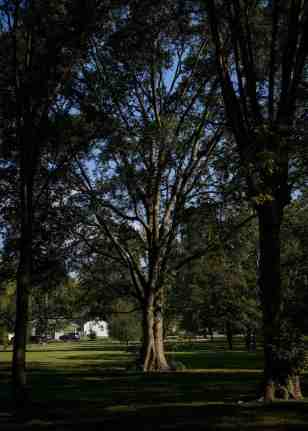
A tale of two trees in Nashville. A mature tree in England Park, left, and a newly planted tree at Wright Middle School.
NASHVILLE — The scene in a tiny pocket park outside Plaza Mariachi here on Nolensville Pike last Wednesday was like a tableau from a Norman Rockwell painting, 21st-century style. Surrounded by signs advertising the Hispanic Family Foundation, Dubai Jewelry, the Dominican Barber Shop and restaurants offering Peruvian, Chinese, Mediterranean and Indian food — as well as a Game Stop franchise and H&R Block — was a small sign that read, “Today: Free trees.”

Photographs by William DeShazer for The New York Times
The arrow on the sign pointed to a pop-up canopy where the Nashville Tree Foundation was hosting its fourth tree giveaway of October. A family standing under the canopy was posing for a photo with the sapling they had just adopted. Carolyn Sorenson, executive director of the foundation, was taking the picture: “Say ‘trees’!” she said.
The tree giveaway at Plaza Mariachi happened to fall on the very day that Nashville’s mayor, David Briley, announced a campaign to restore and enlarge the city’s tree canopy. The effort, called “Root Nashville,” will be overseen by the city and the Cumberland River Compact, an environmental nonprofit, and funded through a combination of public, corporate, foundation and private dollars. Together with several municipal departments and other nonprofit organizations, the initiative aims to plant 500,000 trees in Davidson County by 2050.
Many of these newly planted saplings will replace very large, very old trees that have been lost to Nashville’s meteoric growth — a population increase of more than 45 percent since 2000. As the city has grown, the city’s trees have fallen: deliberately felled by developers to make room for new construction or unintentionally killed as a side effect of nearby building. Just since 2008, the tree canopy in the urban core has dropped from 28 percent to 24 percent, a loss of roughly 9,000 trees a year. Continue reading →



 Organikos