


It’s been 5 years since we first began highlighting the Great Backyard Bird Count, a citizen science collaboration between the Cornell Lab of Ornithology, the Audubon Society and Bird Studies Canada. Since then, we’ve participated in 3 countries, on 2 continents, primarily in birding hotspots such as the Periyar Tiger Reserve in Kerala, India, a special corridor of avian biodiversity in the foothills of Poas Volcano in Costa Rica, and Baja California Sur, Mexico.
The data that is collected by thousands of individual birders for eBird has long range benefits for monitoring both the health and range of particular species, as well as the state of the planet as species have to adapt to changing climate.
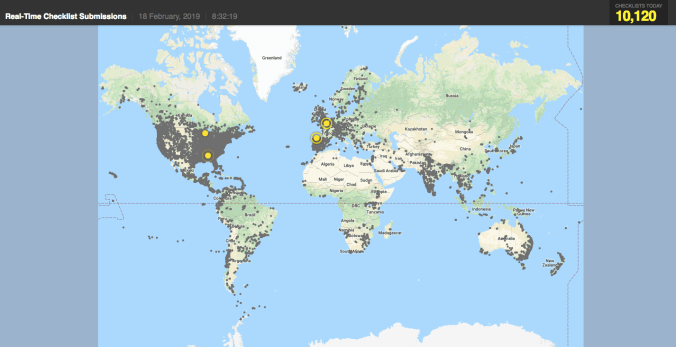
The map above indicates the locations from which checklists have been submitted (each gray dot represents a list, and the larger yellow dots are a moment frozen in time when a list has just been submitted. I highly recommend clicking on the image to view the site and watch the “lists” pop through the map!) Initially the GBBC only took place in North America, and birders worldwide rejoiced when it was expanded into a global event. (We were in India at the time, so I kid you not.) Continue reading

 Organikos