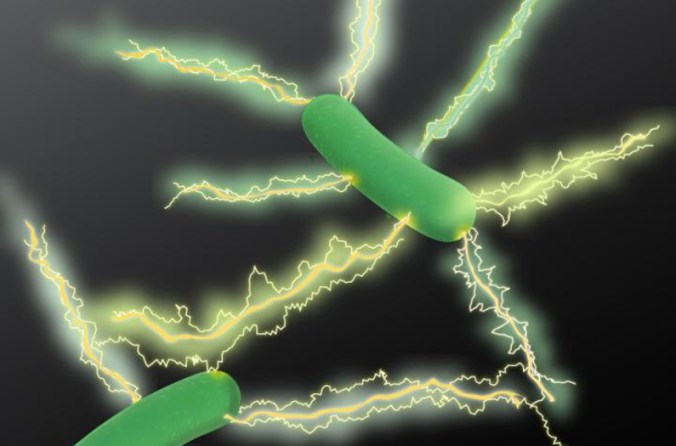
An artist’s rendition of Geobacter expressing electrically conductive nanowires. Credit: UMass Amherst
Thanks to Anthropocene for a great title to this summary of important recent research finding:
From the swamps of the Potomac, new hope for green electronics
Protein filaments just 3 nanometers wide that are produced by certain species of bacteria could be a key to environmentally friendly electronics manufacturing, according to microbiologists at the University of Massachusetts at Amherst.
Scientists discovered the filaments, dubbed “nanowires,” about 5 years ago. Bacteria use them to make electrical connections with other bacterial cells or to generate reactions with metals in the environment. Continue reading
 Organikos