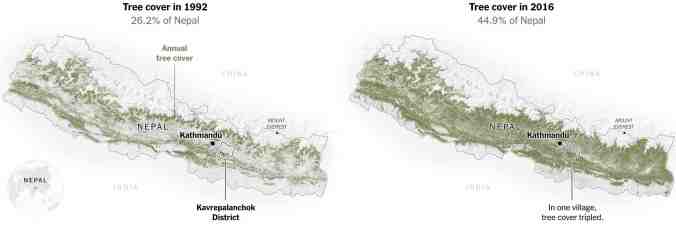
Nepal’s Community Forests

Note: Green areas show land that is mostly covered by trees, based on an analysis of satellite imagery. Source: Jefferson Fox, Jamon Van Den Hoek, Kaspar Hurni, Alexander Smith and Sumeet Saksena.By Pablo Robles

We have shared plenty of stories about Nepal, but until now no story about Nepal involving trees or forests. We welcome this one:

The community forests in Khairahani, Nepal, stretching over several tree-capped hills in March. Karan Deep Singh/The New York Times

An effort decades in the making is showing results in Nepal, a rare success story in a world of cascading climate disasters and despair

KANKALI COMMUNITY FOREST, Nepal — The old man moved gingerly, hill after hill, cutting dry shrubs until he was surrounded by trees that had grown from seedlings he had planted two decades ago. He pointed to a row of low peaks above the Kathmandu valley that were covered with dense foliage. Continue reading
Collaborating In Nepal For Wildlife

Thanks to EcoWatch for bringing this to our attention:

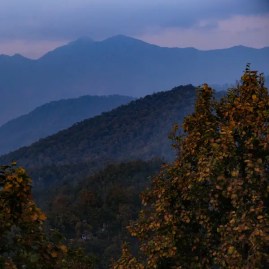
This fall, rangers protecting rhinos, tigers and other endangered wildlife in Nepal’s famous Chitwan National Park will get a solar system that powers one of their isolated stations deep in the jungle. At the same time, local women will get the training and tools they need to sell low-cost clean energy technologies to people living in the buffer zone that surrounds the park. Continue reading

Hiking for E-mail

mahabir pun

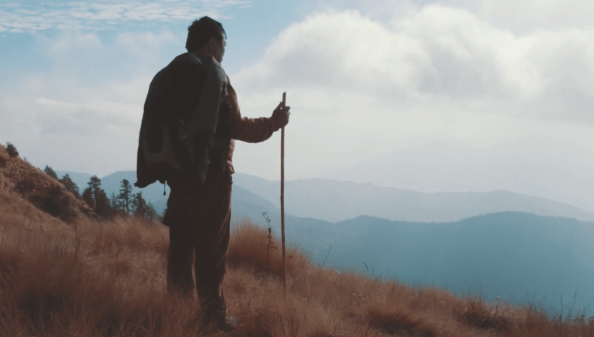
For six years, Mahabir Pun trekked long distances to check emails in Nepal. Until he brought the Internet home to his remote village. PHOTO: Hiking for Emails, Vimeo

In India, there exists this dwindling practice of writing letters to the Editor. Of publications. Most people write on current affairs, some write to highlight issues that range from a lack of streetlights to dissent. Some write in to commend actions, public campaigns. A handpicked bunch of these are published in a column titled Letters to the Editor. Mahabir Pun of a remote village in the mountainous country of Nepal wrote to BBC, asking for help to bring the Internet home.

Continue reading

The Ultimate Architect of Cardboard Buildings

“What is the difference between temporary architecture and permanent architecture?” No architect is more qualified to explore that question than Japanese architect Shigeru Ban. “Temporary” architecture, in disaster zones, is Ban’s calling card. For over 20 years, the 2014 winner of the Pritzker Prize, architecture’s Nobel, has best been known for his well-publicized humanitarian work. From Rwanda to Japan to Nepal, he has turned cheap, locally-sourced objects—sometimes even debris—into disaster-relief housing that “house both the body and spirit,” as Architectural League president Billie Tsien puts it.

Continue reading

The Hope in Calamity

nepali-baby

This five-month-old boy, rescued 22 hours after a 7.8 magnitude earthquake hit Nepal on April 25, is an entire nation’s miracle. SOURCE: kathmandutoday.com

It is not every afternoon that you hear a mention of the Richter scale and your country’s name in the same breath. Unfamiliar it being, you do what seems natural – seek answers. So a call goes to the friend in the capital (New Delhi), who appears to not have felt the tremors that were otherwise shaking headlines. As two people who spent half of each day in the newsroom and well understood the adage of bad news being good news (talk about occupational hazards), we got to the heart of the matter: tremors in India result of a 7.8 magnitude earthquake in the bordering country of Nepal. For comparison, take the 2010 Haiti earthquake recorded at 7.0; both countries share similar economic conditions and the latter continues on the path to recovery, with international aid. We knew the counters had started ticking, headlines were already screaming numbers.

Continue reading