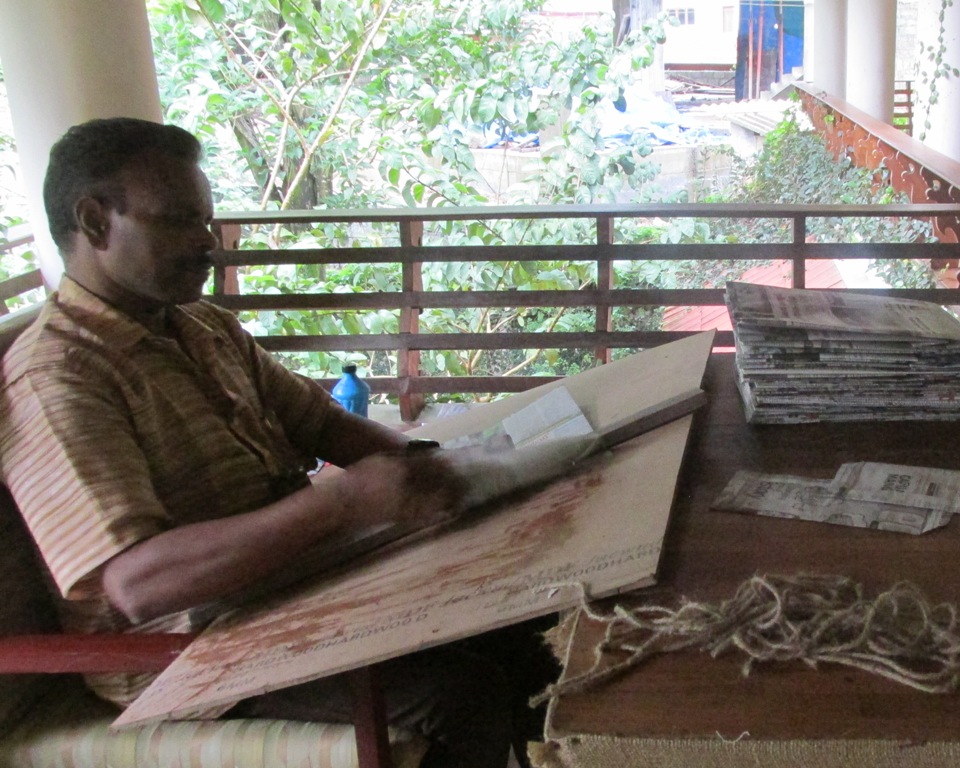
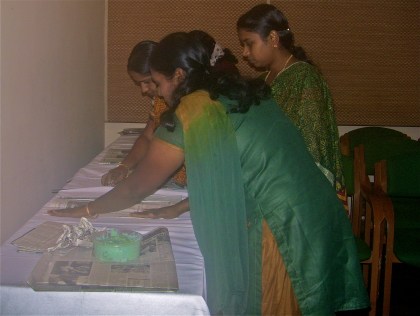
As I suggested in my last post, I’ve recently spent less time in the Periyar Reserve, i.e. observing and chronicling my encounters with the myriad species of plants and animals there, and more time in and with the local community. Working with resort management and Forestry Dept. officials, I’ve been trying to get off the ground a microbusiness enterprise, operated by residents of Kumily and members of the tribal communities in Periyar East, with the initial goal of producing bags from recycled newspaper. This is related to the bigger goal of eliminating the use of plastic bags.
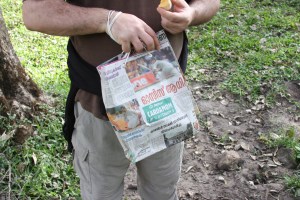
One such bag, made from recycled newspaper
There are several aspects to this project, and as I delve deeper into them the more complex and intriguing it seems to me. I think the easiest and best way to present the full picture, to identify the difficulties and possibilities inherent to it, is to tell the whole story of my involvement in the project, and in the process to clarify the context of my previous posts.
To set the scene, I offer, in shorthand, a cultural backdrop:
What was only recently a subsistence and agricultural culture and economy, the Cardamom Hills (like all of Kerala) has undergone something of an economic and cultural revolution over the past fifteen to twenty years. Though I’m not an expert in this field, I can say, based on firsthand accounts and observations, that as education levels have risen even among the poorest people in this area (Kerala’s literacy rate is, famously, over 90%), and as the opportunity to pursue non-agricultural employment and consume newfangled products has become commonplace in this area, the demand for disposable income and new ways of attaining it has also increased. Generally, this is true of India as a whole, and as a global phenomenon it really deserves a more nuanced treatment than I’m able to give it (for more information, I suggest you go to your local library or see your neighborhood economist). But, on a microcosmic level, it is perhaps most pronounced, complicated, and—in some ways—easily tackled in the tribal communities of India’s forests. Continue reading →



 Organikos