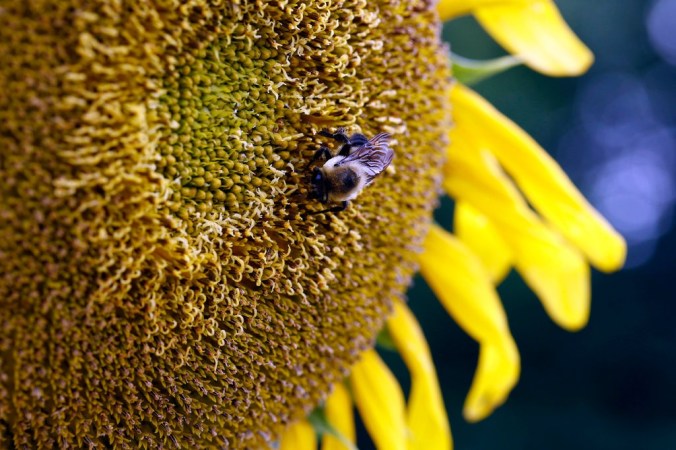
Scientists expected bees to gradually cease buzzing as the sky darkened during an eclipse. Instead, they stopped altogether. Credit Rogelio V. Solis/Associated Press
After following the work of Nicholas St. Fleur for a couple years now–his beat includes archaeology, paleontology, and space among other of the things we care about on this platform, including conservation–his most recent story below is my favorite for one reason, namely citizen science. Specifically the participation of youth in such an important scientific investigation:
The Moon Eclipsed the Sun. Then the Bees Stopped Buzzing.
Researchers worked with a small army of elementary school children to collect audio recordings of bees as they visited flowers along the path of last summer’s total eclipse.
National Forest Service workers at the Bridger-Teton National Forest Office in Jackson, Wyo., took a break to watch the Great American Eclipse last year. Credit Celia Talbot Tobin for The New York Times
Last year’s Great American Eclipse drew hundreds of millions of eyes to the sky. But while people across the country “oohed” and “aahed” at the phenomenon, it appears the bees went silent.
So found a new study that monitored the acoustic activity of bees before, during and after totality — the moment when the moon completely blocked the sun — during the solar eclipse on Aug. 21, 2017. Researchers at the University of Missouri, along with a small army of elementary school children and other volunteers, collected audio recordings of honeybees, bumblebees and other types of bees as they visited flowers along the path of totality Continue reading

 Organikos