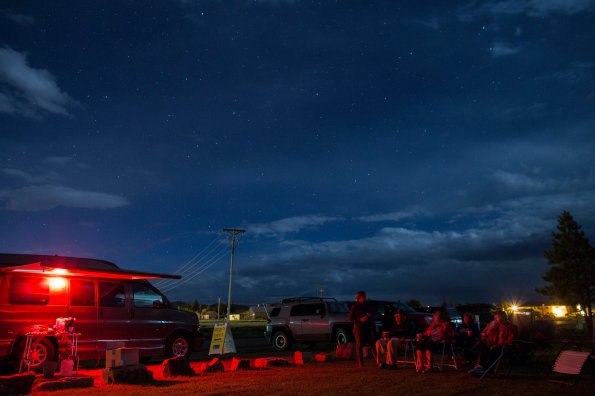
Members of Dark Skies Inc. look for meteors in Westcliffe, Colorado. Source: New York Times
A few days back we wrote about the Perseid meteor outburst taking place between August 11th and 12th and I sincerely hope you had the opportunity to find a remote location with low night pollution to see it because it was truly a cosmic phenomenon (we lay some futon cushions on the back of a pick-up truck, drove out to an area of Gallon Jug fields at three in the morning, and laid back to gaze at the meteor shower).
A couple thousand miles away, residents of towns in the Wet Mountain Valley of southern Colorado, Silver Cliff and Westcliffe, were able to enjoy the display early Friday morning because even from the town’s limits they can see the Milky Way. It is rare to find a town with such low light contamination, but it isn’t a coincidence. Locals have sustained efforts for more than a decade to dial down on the outdoor lighting by not only dimming the light potency but also requiring lights to face downward. These communities are preserving the beauty of gazing out into a star-filled night sky and have benefited from the visitors who started to visit for the purpose of stargazing. Here’s the story as reported by the New York Times:
WESTCLIFFE, Colo. — As people around the world stepped into their backyards or onto rooftops to peer up at the annual spectacle of the Perseid meteor shower early on Friday morning, few of them had a view like Wilson Jarvis and Steve Linderer.

 Organikos