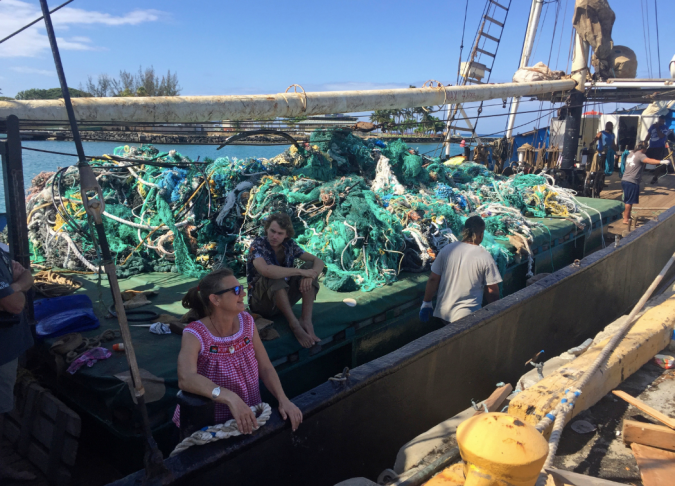
Ocean Voyages Institute’s cargo ship, the S/V KWAI, is docks in Honolulu, Hawaii as it holds fishing nets and consumer plastics collected during a recent 25-day mission in the Pacific Ocean. (Greg Yoder/Ocean Voyages Institute)
It’s an unfortunate truth that plastic is a serious problem in the world’s oceans, so every bit of progress addressing it is good news. Kudos to Mary Crowley and the volunteers at Ocean Voyages Institute for using simple technology to have such profound results.
Ocean Voyages Institute Removes 40 Tons of Plastic, including 5-Ton Ghost Net
Sausalito, CA – Ocean Voyages Institute, a nonprofit organization, announced today that it has successfully removed more than 40 tons of fishing nets and consumer plastics from the area known as the North Pacific Subtropical Convergence Zone, or more commonly known as the Pacific Gyre.
The sailing cargo ship, S/V KWAI, arrived in Honolulu today, having completed a 25-day clean up mission. In the Pacific, between California and Hawaii, four ocean currents converge to create a vortex that collects huge amounts of plastics. One sees detergent bottles, beer and soft drink crates, bleach and cleaning bottles, plastic furniture, packaging straps, buckets, children’s toys, and myriad types of plastic floating mid-ocean. This debris field covers vast expanses of ocean.
A prime target for OV Institute’s 2019 voyage was the fishing gear called “ghost nets.” Often weighing tons, these massive nets of nylon or polypropylene drift for decades, amassing plastic debris, ensnaring wildlife, and even entangling ships. An estimated 600,000 tons of this abandoned gear ends up in the oceans every year. According to the United Nations, some 380,000 marine mammals are killed every year by either ingesting or being caught in it.
“Satellite technology played a key role in our recovery effort, offering an innovative solution to finding areas of dense plastic pollution,” said Mary Crowley, Founder and Executive Director of OV Institute. “The nets and other debris are signs of the proliferating plastic pollution that poses threats to marine life, coastal environments, shipping, fisheries, wildlife and our health.” Continue reading
 Organikos