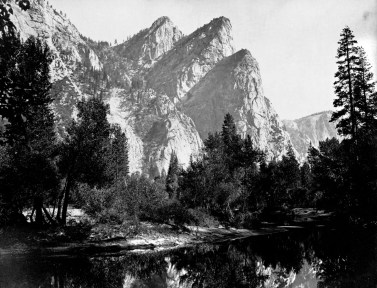
The Three Brothers, taken just east of El Capitan, by Carleton Watkins, ca. 1865. “A sharp earthquake shock at 7:30 a.m.,” Muir wrote in his journal on January 5, 1873. “Rotary motion tremored the river. . . . A boulder from the second of the Three Brothers fell today.” (Courtesy of the Library of Congress)
This book review in the LA Times will be of interest to those who find the history of conservation innovations entertaining:
The odd couple that saved Yosemite
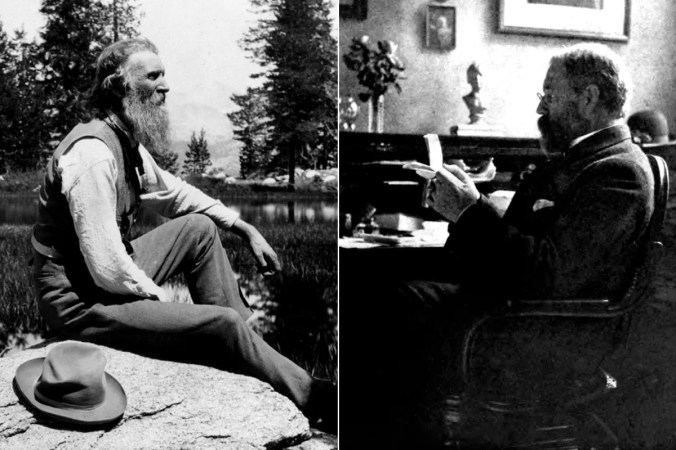
John Muir and Robert Underwood Johnson were unlikely allies in the war to preserve Yosemite. Muir, son of a Scripture-quoting Scottish immigrant father, was raised poor on a Wisconsin farm, but he wrote and spoke with the fervor of a prophet, and his craggy visage, tough constitution and unshakable devotion to the natural world drew admirers like a magnet. The urbane and cultured Johnson was an insider with a vast network of contacts in publishing and politics. The editor of one of the country’s preeminent magazines, Johnson hosted New York literary salons, mingled with America’s elite and eventually became the U.S. ambassador to Italy.
John Muir in California nature, 1902, left, and Robert Underwood Johnson, associate editor of the Century Magazine, at his office on Union Square in New York City. Their complementary skills helped carve out Yosemite National Park.(Courtesy of the Library of Congress; Courtesy of Wikimedia Commons)
It was improbable that they even met — Muir was on the West Coast, Johnson on the East. But on one memorable journey into the California kingdom now known as Yosemite National Park, the two agreed to pull together to wage the nation’s “first great environmental war,” battling through the administrations of seven presidents to save Yosemite. It’s fair to say that the valley’s matchless terrain and fragile ecosystem would have been logged, plowed and plundered without their relentless efforts. Veteran nonfiction writer Dean King tells their story in “Guardians of the Valley: John Muir and the Friendship that Saved Yosemite.” Continue reading

 Organikos