Ants & Agriculture

attaqueennest1cropt1web.jpg__800x600_q85_crop

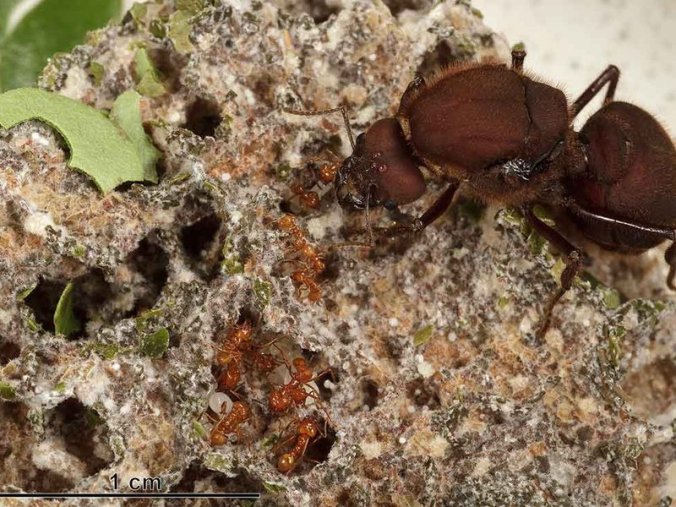
Tiny nurse ants tending to white ant larvae are dwarfed by the queen ant in the upper right. All the ants feed upon protein-rich food produced by a white-grey fungus that they cultivate underground. (Karolyn Darrow)

Thanks to the folks at Smithsonian for this one:

Were Ants the World’s First Farmers?

A new study shows that a group of ants have been conducting a subsistence type of farming since shortly after the dinosaurs died out

By Jackson Landers

Humans have been practicing agriculture for about 10,000 years. But the attine ants of South America (which include the well-known leafcutters) have us beat by a long way.

According to a new paper co-authored by entomologist Ted Schultz, curator of ants at Smithsonian’s National Museum of Natural History, attine ants, which farm on an industrial scale similar to humans, have been carefully cultivating gardens with a complex division of labor to grow an edible fungus. Schultz’s team found that the ants have been doing this far longer than previously believed—up to 65 million years—and that we have much to learn from them. Continue reading


The Gears in Planthopper Nymph Legs

Igor Siwanowicz’s image of planthopper nymph gears won 9th place in the Olympus BioScapes International Digital Imaging Competition. Photo by Igor Siwanowicz, HHMI Janelia Research Campus, Ashburn, Virginia. Via Science Friday.

In September of 2013, Science published a paper by Malcolm Burrows and Gregory Sutton titled, “Interacting Gears Synchronize Propulsive Leg Movements in a Jumping Insect.” The two British biologists were discussing the fascinating structures they had found in the legs of small insects called planthoppers. At the top joints of each pair of legs, the tiny jumping insects had gears with interlocking teeth that synchronized the kicking motion between the two appendages, so that the planthoppers could jump straight rather than slightly to the left or right if one leg had acted even slightly before the other.

Covering the story back in September, Joseph Stromberg wrote for Smithsonian Magazine that:

To the best of our knowledge, the mechanical gear—evenly-sized teeth cut into two different rotating surfaces to lock them together as they turn—was invented sometime around 300 B.C.E. by Greek mechanics who lived in Alexandria. In the centuries since, the simple concept has become a keystone of modern technology, enabling all sorts of machinery and vehicles, including cars and bicycles.

Continue reading

Sweet Sounds

Click the image above for the fourth installment, and best yet, in a series of short posts on Smithsonian’s website, discussing the relationship between food and sound:

The sound of food matters. So does the sound of the packaging and the atmospheric sounds we hear when we’re eating. We’re all synesthesiates when we sit down to dinner.

Continue reading

Photographing New Frontiers

At first glance, we want to go there.  Is it somewhere in the southwest of the United States, or maybe those amazing mountains in Jordan where the dwellings of Petra might be just around the corner? Continue reading

Biking In The Catlins

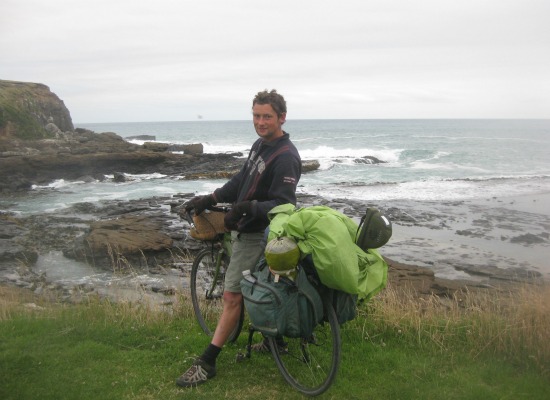
Facing off with the edge of the world, where the gray and blustery waters of the Southern Ocean meet the rocks of Curio Bay, in the Catlins (New Zealand). Photo by Geoff Green.

Today, a post on the Smithsonian blog (sub-blog?) called “off the road” catches our attention.  The photograph on its own would be enough to catch the eye, but reading this fellow’s several paragraphs about a place called the Catlins is enough to get on the raft and start paddling to New Zealand (if, like us, you like faraway places):

A main claim to fame of the Catlins is the area’s high latitude. Slope Point is the southernmost spot of land on the South Island, at 46 degrees, 40 minutes south. Oh, come on, now. Don’t raise your eyebrows and whistle like that. Seattle, for example, boasts a latitude of 47 degrees, and Glasgow goes just under 56 degrees. Yet I’ll grant that the Catlins are farther south than Tasmania, than Cape Town and than most cities in South America. This is, indeed, among the southernmost settled areas on the planet.

Continue reading

Progress Back And Forth

We have noted before the intriguing coincidences that link the “old world” to the “new world”–not least the desire to establish trade with what is now Kerala and the accidental discovery of somewhere else; and other links in both directions.  “Old” and “new” become fuzzy qualifiers when considering “modern” European travelers of the 15th century sailing to “ancient” India and instead encountering people we now call Pre-Columbians.  Seth has posted on the environmental impacts of people from that so-called old world as they settled in the new world and brought their definitions of progress with them.  Now, thanks to an article in Smithsonian Magazine our attention is brought to a book and a man who broaden our horizons back to the old world from which those people came. Continue reading