A Rio Restaurant Feeding the Homeless

img_9450-hero

All images from modernfarmer.com

Before the start of the Olympics, I shared a story about Rio de Janeiro that put a slightly dour mood onto the prospect of the international event. However, there are other important stories to share that cast a much brighter light on Brazil’s second-most populous city. Here’s an inspirational story about a restaurant in Rio that exemplifies a business model rooted on two principles, altruism and sustainability, and is helping solve two major problems in the city: feeding the homeless and decreasing food waste.

by Andrew Jenner

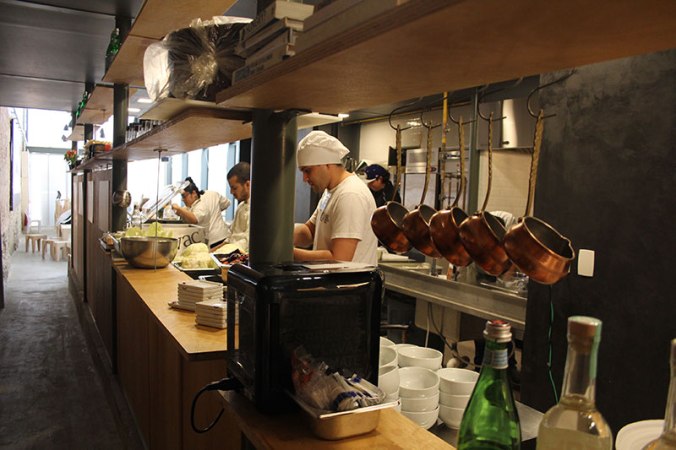
It’s coming up on 1 p.m. on Saturday, and the kitchen staff is hard at work. On one end, they’re chopping cabbage, onions, chayote, and a chicken. On the other, another pair of cooks preps a tangerine and carrot sorbet. Massimo Bottura—a dude with owlish glasses whose establishment in Italy was just named the world’s best by the British magazine, Restaurant—peeks over their shoulders with encouragement and a caution: easy on the sugar, OK?

In the front of the house, volunteers wander to and fro, harried people jab their phones, and a Telemundo TV crew jockeys for a few minutes with Bottura and David Hertz, the Brazilian chef and social entrepreneur who represents the other half of the brains behind the place. Outside, a generator outside throws off diesel fumes and a hellish racket, while construction workers tear apart the sidewalk to—Bottura and Hertz desperately hope—fix some issue with the kitchen’s gas supply. It’s one of a million little problems this little restaurant has faced, but Refettorio Gastromotiva is the little restaurant that could.

Continue reading

When Mines Threaten to Swallow Cities

Kiruna is Sweden’s northernmost city, and soon, it's about to pick up and move two miles to the east, thanks to a mine. PHOTO: Co Exist

Kiruna is Sweden’s northernmost city, and soon, it’s about to pick up and move two miles to the east, thanks to a mine. PHOTO: Co Exist

Kiruna is home to the world’s largest underground iron ore mine, LKAB, supplying iron ore pellets to the steel industry in Europe. In most places, ore is extracted in opencast mines but not in Kiruna. The ore body in Kiruna is four kilometers long and 80 meters wide and stretches for at least two kilometers in the ground. For the moment, they mine at 1 km deep in Kiruna but they plan to mine until at least 2030 because they don’t know the extent of the ore body. But the city is sinking.

Continue reading

Socially Responsible Investing: An Ineffective Struggle or a Powerful Tool?

Barbara Krumsiek, President and CEO of Calvert Investments, has led the company for 15 years.

Two summers ago, I had the pleasure of working at Calvert Investments, a Bethesda-based socially responsible investing (SRI) firm. The words “socially responsible investing” would often raise eyebrows as I attempted to concisely describe to other hotelies at Cornell what exactly Calvert does. Socially responsible investing is broadly defined as a holistic approach to investing that considers both the economic and social/environmental returns of your money. Although SRI accounts for less than five percent of all general investment funds, it is a growing field with potential. Cornell’s business school has had some interesting takes on this asset class.

So what does SRI look like? There are many different approaches, so I’ll just describe what Calvert tries to do. From Calvert’s view, it is an extensive process of research, indexing, and investing. First, we perform research on firms that we potentially want to invest in or that our clients are asking us to invest in. The research is comprehensive and looks primarily at environmental, social, and governance (ESG) issues for a specific company. For example, imagine that we’re considering to invest in BP. Some of the research we might do would ask these types questions (again, these are hypothetical, and they only skim the surface):

  • Environmental factors: How many oil spills have there been in the past year? What environmental remediation plans are in place? Is in-depth environmental training provided for employees? Does the firm mine/drill in high-risk areas?
  • Social factors: Are workers paid a living wage? Does the firm employ child labor overseas? What human rights violations has the company committed?
  • Governance factors: What proportion of women make up the board of directors? Has the company been investigated for anti-competitive activities? Has the firm been investigated by the SEC for trading violations? Have there been attempted hostile takeovers?

Continue reading