Stephen Greenblatt & Old School Text, Messaging About Our Future

170619_r30116-800.jpg

Poring over the story of Adam and Eve, Augustine came up with original sin. Illustration by Malika Favre

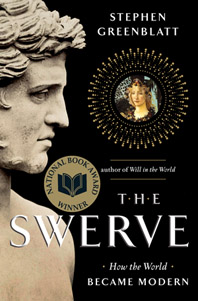
I recall the odd thrill of almost missing The Swerve and then realizing that in my remote location in the East, the classical canon of the West was more important than ever. And this scholar has a way with words, which now more than ever is much-needed balm. So, I am looking forward to this new installment of his work:

…Hardly a world-historical event, but the boy was named Augustine, and he went on to shape Christian theology for both Roman Catholics and Protestants, to explore the hidden recesses of the inner life, and to bequeath to all of us the conviction that there is something fundamentally damaged about the entire human species. There has probably been no more important Western thinker in the past fifteen hundred years. Continue reading


The Swerve, Prized Again

File photo by Stephanie Mitchell/Harvard Staff Photographer

I have already said how surprising I found it that writing about the influence of classical literature on modern thought can be so effectively illuminated; in fact I could not help but say it a couple of times.  On this site we like to celebrate the success of our favored visionaries, writers, producers, educators, artists, thinkers, doers.  One of the publications at the university where he teaches had special reason today to put his name in visible circulation (click the image above to go to the story) with the announcement mentioned here:

Greenblatt’s book, which describes how an ancient Roman philosophical epic helped pave the way for modern thought, was awarded the 2012 Pulitzer Prize for general nonfiction.

In its citation, the Pulitzer board described “The Swerve” as “a provocative book arguing that an obscure work of philosophy, discovered nearly 600 years ago, changed the course of history by anticipating the science and sensibilities of today.”

Continue reading

Lucretian Illumination

In a post some months ago I described the unexpected, but seemingly preordained, encounter with the concept of “swerve” in an article this man had written. Then today, this reference to Moby Dick and in particular the words “high time” triggered an interest in hearing The Swerve‘s author speak about those ideas.  The five minute wonder above hit the spot. Continue reading

Almost Missed It

It is just the way things are.  My reading list/pile is always longer/taller than I have time for.  And living between the rice fields and spice-laden Western Ghats I do not have access to the kind of bookstores we took for granted while living elsewhere.  Amazon does not deliver in India, nor would I put a penny in their coffers until I have the sense that they are not trying to monopolize the book trade, not to mention everything else.

Even if I had access to a great book store I might not have picked this one up off the shelf, though I admire the author’s writing.  I have not been in the mood for anything too canonical or Great lately; rather merely useful, interesting, lesser reading.  Short- and long-form journalism tend to be my standard fare. There was something in the pile with Greenblatt’s name on it, a magazine article, that I kept burying for months and which persistently kept resurfacing. Continue reading