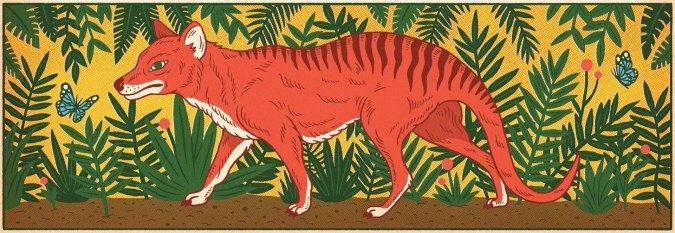
Like the dodo and the great auk, the Tasmanian tiger is more renowned for the tragedy of its death than for its life, about which little is known. Enthusiasts hope it will be a Lazarus species—an animal considered lost but then found. Illustration by Bene Rohlmann
We thank Brooke Jarvis for her reporting on this compelling tale:
The Obsessive Search for the Tasmanian Tiger
Could a global icon of extinction still be alive?
Andrew Orchard lives near the northeastern coast of Tasmania, in the same ramshackle farmhouse that his great-grandparents, the first generation of his English family to be born on the Australian island, built in 1906. When I visited Orchard there, in March, he led me past stacks of cardboard boxes filled with bones, skulls, and scat, and then rooted around for a photo album, the kind you’d expect to hold family snapshots. Instead, it contained pictures of the bloody carcasses of Tasmania’s native animals: a wombat with its intestines pulled out, a kangaroo missing its face. “A tiger will always eat the jowls and eyes,” Orchard explained. “All the good organs.” The photos were part of Orchard’s arsenal of evidence against a skeptical world—proof of his fervent belief, shared with many in Tasmania, that the island’s apex predator, an animal most famous for being extinct, is still alive. Continue reading
 Organikos