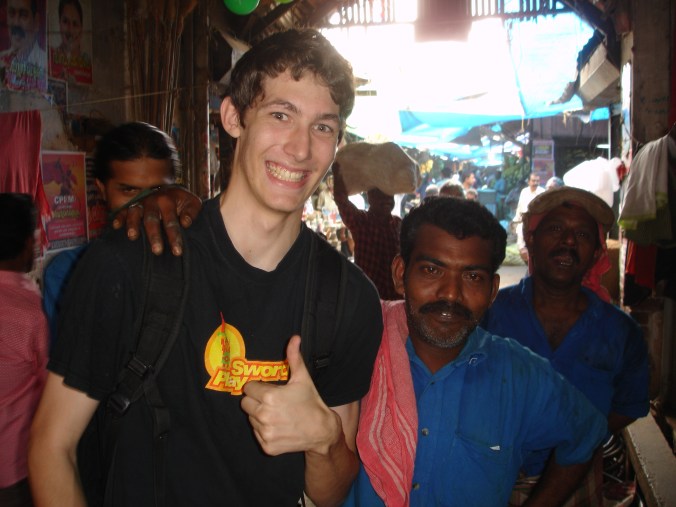
In my own favorite post of the last few months (Kerala: Seeing & Learning), I briefly mentioned the word. But I didn’t make it clear just how hilarious the instances of its utterance can be, especially when the subject knows its significance.
A New Zealand writer who lived in Kerala for a few years describes a few bizarre Continue reading →
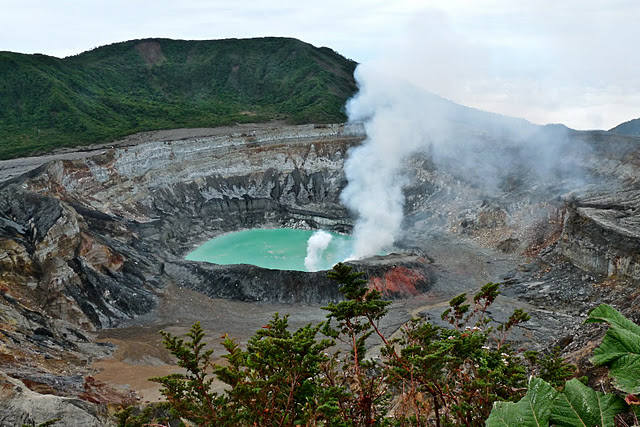
One volcano-related assumption which I’ve had to let go of since arriving in Central America is that a volcano is a volcano.
Anyone who grows up in Scotland knows that mountains are not just ‘mountains’. There are mountains, but there are also ranges, hills, Bens, and Munroes. There are the kind that, although tall, the fitter of us can walk up without much in the way of equipment; there are others which may be smaller but are impassable unless you really know what you’re doing.
Pierre and I took a walk around Granada today with Mombotour guide Gustavo, a native of the colonial city. Our first stop was the San Francisco Monastery and Church, the oldest church in Central America, which has been converted (aha) into a museum of colonial and pre-Colombian history. Probably built on the site of an indigenous temple, the monastery later became a school, then the museum. It also recently underwent a restoration project, since earthquakes have especially strong effects on such old architecture as Granada’s churches.
Gustavo led us through each of the rooms containing an exhibit, such as ancient pottery, contemporary art replicating historical or cultural scenes, and zoomorphic stone statues. He explained some of the beliefs held by the indigenous groups, which were often influenced by northern tribes (Mayans, Toltecs, and Aztecs) and South American indigenous nations, as well as the Spaniards’ opinions of them. For example, the rain god was considered to have four sons at the cardinal points. Ritual offerings such as those depicted in this painting were thought to bring fertility to the soils. Spaniards were also quite surprised to see the symbol at the base of this statue, not knowing that it represented the cardinal points and not the savior. Continue reading →
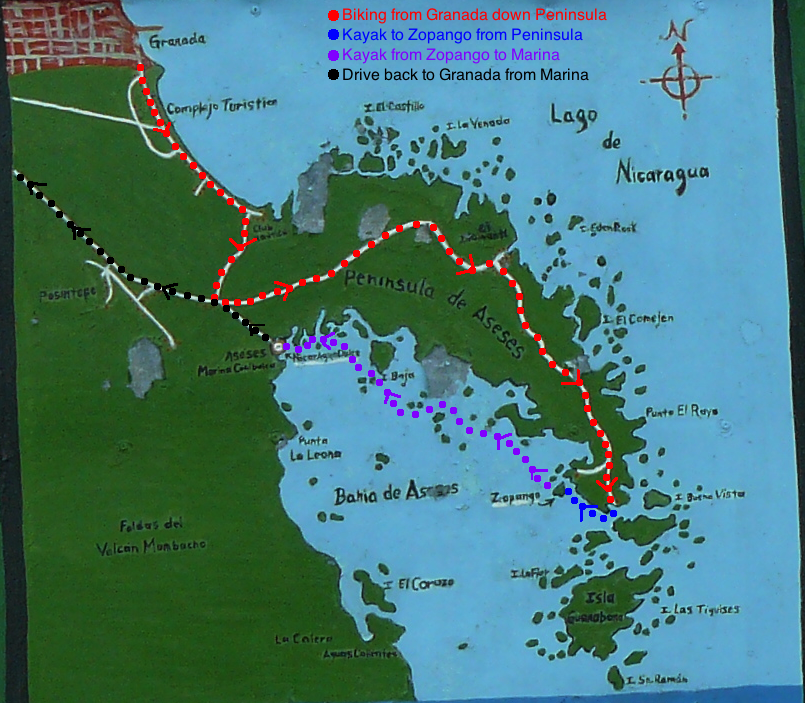
This morning Pierre and I went on a trip facilitated by Mombotours, using Detour bikes and NicarAgua Dulce kayaks. Eddy, our guide from Mombotour, arrived after breakfast and drove us to Detour, the bike rental shop. We picked up three bikes and left Granada’s hub towards the shore of Lake Cocibolca. The Mombotour driver followed behind in the truck in case we had any bike problems or accidents. We hadn’t gone more than two or three kilometers when the truck’s presence became needed. I’d accidentally driven over some glass, and punctured my tire in two places with tiny shards. With the tools and spare tube in the truck we were able to fix this unfortunate damage within twenty minutes, and Eddy’s training made my negligible REI workshop experience unnecessary.
The rest of the bike trip, which lasted about an hour and a half, was without further perforations, and we enjoyed riding up and down muddy dirt roads, dodging stones and chickens along the way. The mountain bikes performed very well and changed gears fluidly, which is always a nice surprise. We rode down along a peninsula till Continue reading →
Early this morning Pierre and I set out from Morgan’s Rock towards Granada, which is maybe two and a half hours away. Before reaching the city, we turned onto a road that led to Mombacho Volcano, an inactive peak with several extinct (and some fully collapsed) craters. The volcano is protected by the Mombacho Volcano Nature Reserve, created in 1996 by the several local fincas on the volcano’s foothills that comprise the NGO Cocibolca Foundation. Our time at Mombacho, described in the rest of this post, is part of the exploratory trip that Pierre and I are taking over the next three days, assessing the possibility of connecting Morgan’s Rock’s tour offerings with other operators in the area.
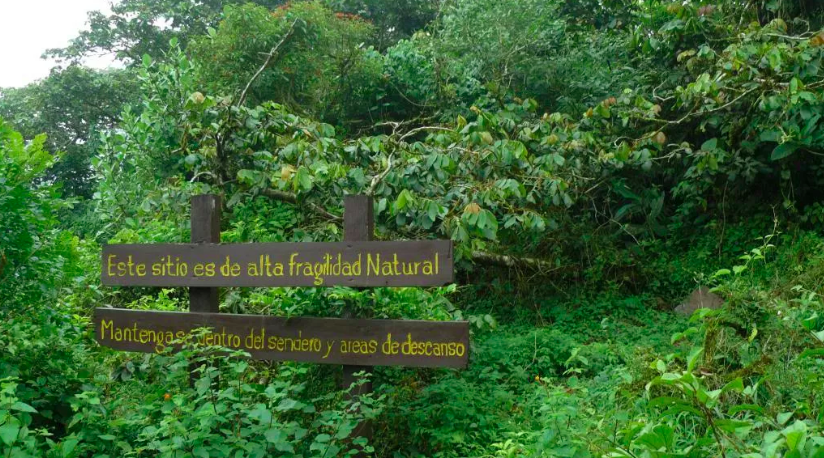
The day’s activities started at the Mombacho Volcano Nature Reserve (MVNR), where we met our guide Jennifer. We decided to take the longest trek, called the Puma Trail, so named because there are some big rocks and even caves that pumas are said to live in, although none have been sighted in a decade. Prior to starting this four-hour hike we stopped by an area called Los Fumalores where Jennifer had fun by daring us to put our hands in a small hole next to the trail, reassuring us that no snakes would be inside. As we placed our hands near the opening in the ground, we could immediately feel a stunning temperature difference. The place is called Los Fumaroles because sulfuric gases rise from volcanic holes and crevasses in hot gushes, heating the surrounding stone to a surprising degree. This area also provides a nice view of Las Isletas, which are known as children of Mombacho because they are islands initially created from a volcanic eruption. I mentioned Las Isletas very briefly here.
In my last post, I claimed that only a small number of studies have been done on valuating eco-tourism as an ecosystem service. I was wrong. After some more digging around, I’ve discovered that a fair number of studies address this topic, though only a small number of studies actually evaluate specific regions of the world. One of the most interesting reports I stumbled upon was from the Journal of Environmental Management. In 1998, Susan Menkhaus and Douglas Lober, two researchers from Duke University, published a paper that focused on Costa Rican rainforests and their ecotourism value. If you’d like to read the whole thing, it’s titled “International Ecotourism and the Valuation of Tropical Rainforests in Costa Rica.”
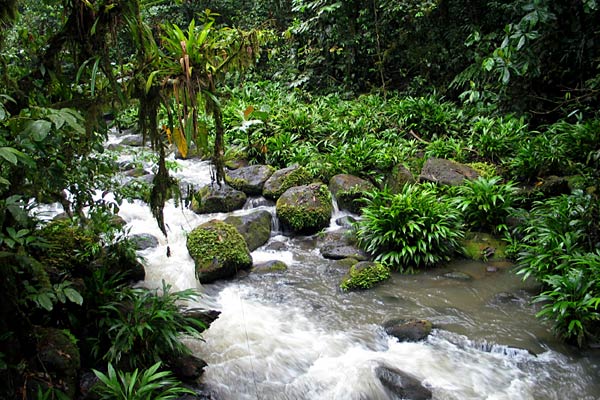
Rainforests provide dozens of ecosystem services. In Costa Rica, they serve the booming eco-tourism industry.
By way of background, Costa Rica is a textbook example of effective management of natural resources, tourism, and integrated public policy. It is widely recognized as the greenest country in the world, and it remains the most visited Central American country. Covering less than 0.05% of Earth’s landmass, Costa Rica contains a whopping 5% of the world’s biodiversity, has 12 different life zones, and boasts one of the highest land protection rates in the world. Nearly half of the tourists that come to Costa Rica engage in some sort of eco-tourism activities. Needless to say, Costa Rica is the best nation to take as an example for this study, which attempts to quantify the value of Costa Rica’s rainforests from a tourism standpoint. Keep in mind, however, that the authors only sought to calculate the eco-tourism value of the rainforests—not anything else related to the forests’ medicinal, timber, or biodiversity value. Continue reading →
I was recently walking around in a neighborhood park, and I saw birds splashing in a pool of water. I watched a pair of squirrels play tag up and down a large oak tree, and I admired an elderly couple walking hand-in-hand in a flower garden. Then, I heard a car door slam and my eyes beheld children entering the park hardly lifting their gaze from their electronic devices as debris flew from their car. As I raced to retrieve and dispose of the litter, my mind quickly volunteered pieces of itself to give to them and their parents. How could this world’s future generation be so oblivious to the natural environment? And especially when global climate issues are so prevalent? Continue reading →
A good friend of mine has been working on developing a curriculum for sustainability lessons in Utica, and she asked me just a couple days ago for some help with the topic of ecosystem services. I thought it strange that she came to me (a hotelie, no less) for help on such a scientific topic, and I had to admit to her that my knowledge of the topic was shallow. Nonetheless, I pointed her to the UN’s 2005 Millennium Ecosystem Assessment (MA), the four-year study that is considered by the environmentalist community as the go-to resource on ecosystem services. I had skimmed the hefty 155-page synthesis report a few months earlier—I’d only initially did it because Eric Ricaurte, my research adviser, had recommended it to me—and I didn’t remember much from it. So after recommending the MA, I decided to read through some sections of it again.
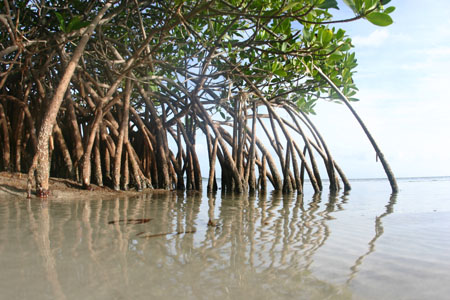
Mangroves are a recognized source of ecosystem services. They buffer against storms, prevent erosion, and filter out toxins.
By way of background, ecosystem services are resources and processes that the natural environment provides for us. For example, trees provide oxygen for us to breathe, fish in the ocean serve as food, and earthworms help decompose our waste. But what caught my eye immediately from the Millennium Ecosystem Assessment was how it recognized ecotourism and recreation as important ecosystem services for humans. I couldn’t help but smile: while attempting to preserve their surrounding environments, eco-resorts around the world are also drawing upon this valuable ecosystem service by deriving revenue from it. Continue reading →
One of the more interesting responsibilities of my current internship here in DC is to peruse news articles and company/NGO reports that relate to corporate social responsibility. Last week, one particular report caught my eye because of its relevance to travel and tourism. Brighter Planet, a sustainability research and reporting company, recently published a white paper on airline efficiency. The paper, titled “Air Travel: Carbon and Energy Efficiency,” struck me as ironic. Air travel is a highly emissions-intensive mode of transportation and seemingly incompatible with sustainability. It accounts for 2% of global greenhouse gas emissions, a large number for a single industry.
Brighter Planet’s report, however, did not seek to justify flying. It instead analyzed a decade’s worth of data on a host of fuel consumption metrics on all major airlines. What the research found was intriguing and useful. The efficiency of a flight that you take is influenced by countless factors, but there are five main “efficiency drivers” that most significantly impact the GHG emissions of a flight: aircraft model, seat density, load factor, freight share, and distance. I’ll do my best to explain each of these briefly. Continue reading →
Since I arrived in Bangalore airport on June 3, I’ve heard about Baba Ramdev and his highly publicized, nine-day fast. What I learned today was that, while Ramdev was being treated for weakness due to his hunger strike, another, less-publicized hunger striker, Swami Nigamananda, was being treated in the same hospital. Nigamananda had been fasting for nearly four months (114 days!) to protest illegal pollution in the River Ganga, a holy site for practicing Hindus and also a vital source of water for nearly 400 million Indians. He died this morning, the last days of his strike overshadowed by Ramdev’s.
Before I left the U.S., many friends and family members had told me emphatically, don’t drink the water! When I would ask why, they replied as if it was common sense: well, it’s dirty. Some had apocryphal stories about some friend of theirs who had gotten sick after drinking from a tap in India, and I typically left it at that. But Nigamananda’s death raised the question again in my mind: why is water in India dirty? Is this just some immutable fact, some geological curiosity, or is it rather a human-created problem worth addressing?
These questions aren’t easily answered, just as any question posed about a nation as diverse and large as India is not. There are as many reasons why some water is dirty and some is clean, and investment in hi-tech treatment facilities isn’t always the difference (though it’s a start). I’m only recently wading into the dense information surrounding Indian water policy, the role of industrial polluters along India’s rivers in dirtying the water, and what is being thought of to clean up the situation.
Because let’s not forget: if clean tap water can’t be had, besides boiling all water, the alternative for the consumer is…bottled water. In the States, more and more people are coming to an awareness of the destructiveness of bottled water, but in most areas of the U.S. clean tap is readily available and people have a simple choice to make in how they get it. In India, this choice is not so simple.
The availability of clean water is a pressing environmental, health, and national security problem for the resident of India. But it’s also a problem for the traveller. As the number of empty bottles of water in my room mounts, and as the monsoons continue to dump rain on me all day, I have to think: am I doing everything I can to combat this problem? As I increase the amount of boiled water I drink, I also am inclined to think more broadly. I’ll let you know what I come up with as I investigate the problem further.
In the mean time, here’s a video (by the same women who did ‘The Story of Stuff,’ which I highly recommend, though I sometimes can’t stand her tone) about bottled water v. tap water, with an emphasis on the U.S. India makes a guest appearance about half-way through, though in an unexpected way.


 Organikos