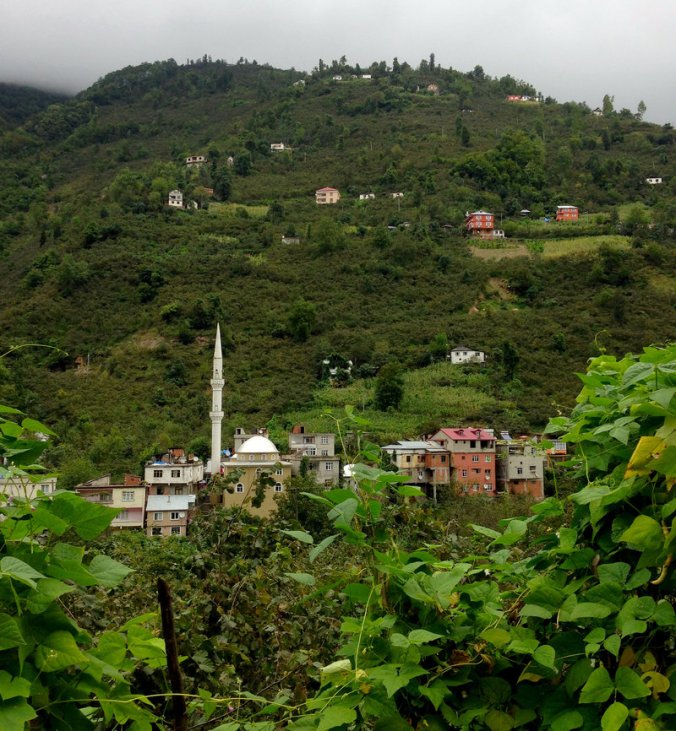
Steep hills surround the village of Kuskoy. Some villagers here can still understand the old “bird language,” a form of whistled Turkish used to communicate across these deep valleys. PHOTO: Peter Kenyon/NPR
Is it always necessary to use words to communicate? Theoretically, there’s verbal communication and its non-verbal counterpart of body language, gestures, and the like. What if the communication is to pass over valleys and hills – spontaneously? Then, a whistled language – with its origin in bird calls – is the answer. Ask the “bird whistlers”.
In a remote mountain village high above Turkey’s Black Sea coast, there are villagers who still communicate across valleys by whistling. Not just whistling as in a non-verbal, “Hey, you!” But actually using what they call their “bird language,” Turkish words expressed as a series of piercing whistles.
The village is Kuskoy, and it’s inhabited by farmers who raise tea, corn, beets and other crops, and also keep livestock. The landscape is unusual by Turkish standards, and the residents are also considered a bit eccentric by other Turks.
Continue reading →

 Organikos