Wendell Berry Here & Now

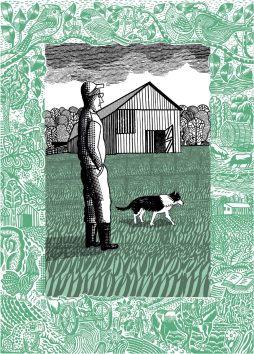
Berry has found a kind of salvation—and a lifelong subject—in his stewardship of the land he farms in Kentucky. Illustration by John Broadley

When we previously mentioned him it was without as much background as he deserved. So now, a corrective titled Wendell Berry’s Advice for a Cataclysmic Age, by Dorothy Wickenden. It  comes with a set of photographs that motivate you to read on:

Sixty years after renouncing modernity, the writer is still contemplating a better way forward.

Hidden in the woods on a slope above the Kentucky River, just south of the Ohio border, is a twelve-by-sixteen-foot cabin with a long front porch. If not for the concrete pilings that raise the building high off the ground, it would seem almost a living part of the forest. Readers around the world know the “long-legged house” as the place where Wendell Berry, as a twenty-nine-year-old married man with two young children, found his voice. As he explained in his essay by that name, he built the cabin in the summer of 1963—a place where he could write, read, and contemplate the legacies of his forebears, and what inheritance he might leave behind.

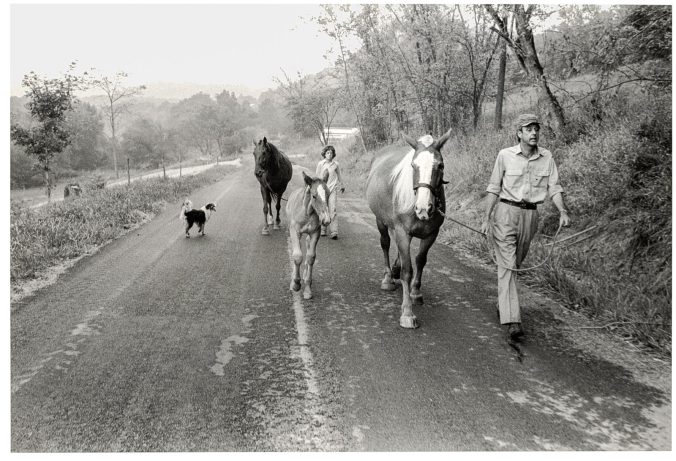
When Berry moved to the country with his wife, Tanya, he gave her a privy that “never aspired so high as to have a door.” Photograph by James Baker Hall

The cabin began as a log house built by Berry’s great-great-great-grandfather Ben Perry, one of the area’s first settlers, and it lived on as a multigenerational salvage operation. Continue reading
Letters to Young Farmers

PHOTO ILLUSTRATION BY THE DAILY BEAST

The reference of the title isn’t lost on us, for the “everyday act of creation”, of coaxing bounty from the soil, is a form of poetry. We applaud both the advisors and the ears on which the advice falls.

Letters to a Young Farmer is full of good counsel for the next generation from the likes of Wendell Berry, Michael Pollan, and the noted novelist Barbara Kingsolver.

Dear young farmer,

Let me speak to you as a familiar, because of all the years I’ve cherished members of your tribe. Of course, I also know you’re only yourself, just as I remember the uniqueness of every intern, WWOOFer, and summer weed-puller who has spent a season or two on our family’s farm. Some preferred to work without shoes. Some were captivated by the science of soils, botany, and pest management. Some listened to their iPods, or meditated, or even sang as they hoed and weeded, while others found no music among the bean bee­tles. A few confessed to finding this work too hard, but many have gone on to manage other farms or buy places of their own. In these exceptional souls I invest my hopes….

Continue reading

Wendell Berry Sharing His Wisdom, With Gandhian Revolutionary Overtones

You have heard his name enough times to recognize it, but you may not be sure what for. If this guy is in the room to listen, it is likely to be interesting. Thanks to Bill Moyers for sharing this:

Wendell Berry, a quiet and humble man, has become an outspoken advocate for revolution. Continue reading

Cooked By Pollan


A new book by one of our go-to food writers in a publication new to us:

The following is an excerpt from Michael Pollan’s Cooked: A Natural History of Transformation, out from the Penguin Press on April 23.

As I grew steadily more comfortable in the kitchen, I found that, much like gardening, most cooking manages to be agreeably absorbing without being too demanding intellectually. It leaves plenty of mental space for daydreaming and reflection. One of the things I reflected on is the whole question of taking on what in our time has become, strictly speaking, optional, even unnecessary work, work for which I am not particularly gifted or qualified, and at which I may never get very good. This is, in the modern world, the unspoken question that hovers over all our cooking: Why bother? Continue reading