
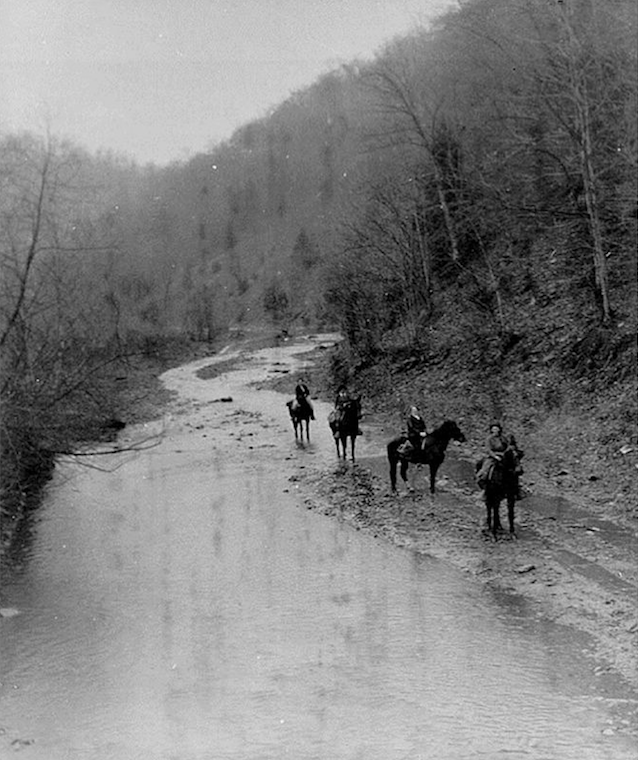
A Pack Horse Librarian returning over the mountain side for a new supply of books (Part of Goodman-Paxton Photographic Collection, Kentucky Digital Library)
We’ve long held the belief that librarians are among the real life Super Heroes of society. The history of the Pack Horse Librarians may be new to us, but without doubt, they deserve a pinnacle spot in the pantheon.
There are both rural and urban communities in our country that continue to qualify as “at risk” related to the official support received for the public educational and cultural services that libraries represent. Some of the New Deal programs that helped millions of Americans survive the Great Depression seem advisable in the face of administrations that turn their backs on libraries and other equivalent cultural elements that helped make the country great.
Horse-Riding Librarians Were the Great Depression’s Bookmobiles
During the Great Depression, a New Deal program brought books to Kentuckians living in remote areas
Pack Horse Librarians start down Greasy Creek to remote homes of mountaineers anxious for books. (Part of Goodman-Paxton Photographic Collection, Kentucky Digital Library)
Their horses splashed through iced-over creeks. Librarians rode up into the Kentucky mountains, their saddlebags stuffed with books, doling out reading material to isolated rural people. The Great Depression had plunged the nation into poverty, and Kentucky—a poor state made even poorer by a paralyzed national economy—was among the hardest hit.
The Pack Horse Library initiative, which sent librarians deep into Appalachia, was one of the New Deal’s most unique plans. The project, as implemented by the Works Progress Administration (WPA), distributed reading material to the people who lived in the craggy, 10,000-square-mile portion of eastern Kentucky. The state already trailed its neighbors in electricity and highways. And during the Depression, food, education and economic opportunity were even scarcer for Appalachians.
They also lacked books: In 1930, up to 31 percent of people in eastern Kentucky couldn’t read. Residents wanted to learn, notes historian Donald C. Boyd. Coal and railroads, poised to industrialize eastern Kentucky, loomed large in the minds of many Appalachians who were ready to take part in the hoped prosperity that would bring. “Workers viewed the sudden economic changes as a threat to their survival and literacy as a means of escape from a vicious economic trap,” writes Boyd.
This presented a challenge: In 1935, Kentucky only circulated one book per capita compared to the American Library Association standard of five to ten, writes historian Jeanne Cannella Schmitzer,. It was “a distressing picture of library conditions and needs in Kentucky,” wrote Lena Nofcier, who chaired library services for the Kentucky Congress of Parents and Teachers at the time. Continue reading
 Organikos