We often talk about ‘imagination’ as if it’s a fixture of the human mind. Human beings, as common sense would have it, are inherently able to imagine what is different; we bring what is distant near only by thinking it so. In the middle of a blistering New England winter, for instance, we might picture ourselves on a sandy beach in Florida; in the mess of rapid and haphazard “development,” we might imagine pristine, virgin land.
But imagination—like all of our most transcendent capacities—exists not invariably, of course, but in degrees, in flux, in varying quantities and qualities, and sometimes—that is, in some minds—hardly at all. I was reminded of this last week following the death of North Korean dictator, Kim Jong-Il, which caused me to reflect upon (and imagine) the lives and minds that comprise a nation with only one permitted text upon which to project its fantasies—the doctrine of North Korean socialism.
And yet this extreme example serves only as a limiting case, one which indicates a more universal difficulty. We’re all always limited in our imaginings. We block their course, sometimes deliberately, but also sometimes mechanically, and often blindly. This is what makes routine possible, and what makes even our most arbitrary and destructive habits seem perfectly natural. We cling to what is readily available, forgetting the partial nature of our given sphere. While imagination brings what’s distant near, habit forgets the possibility of distance (and difference) at all.
Cultivating one’s imagination is a privilege, one which we ought to covet and guard with jealousy. I was granted this privilege this past summer, when I was able to stay in Kumily, Kerala for two months—Kumily, a place so unlike any of the other places I call home in custom and in ambience, in ethic and in landscape. I wrote previously about how the hills and depths of the Periyar moved me, and about how Raxa Collective’s work with the Forest Department and the Development Committees humbled and inspired me. But in that post I neglected to mention one of the more memorable moments of my stay at Cardamom County, one which broadened the horizons of my imagination even more than the occasional monkey-encounter or motorcycle ride through Tamil Nadu.
A bit of personal context, here, for the reader who hasn’t perused my earlier posts: I spent most of my adolescence in a suburb of Orlando, Florida. I grew up among commercial Hummers and commuter highways, amidst endless plastic and soda cans, alongside chains of big-box stores where the air-conditioning never ceased to blast—that is, amidst boundless, seemingly infinite energy. I remember early fights with my mom as she tirelessly and thanklessly harped on me about turning off the lights; as a twelve-year-old, I couldn’t for the life of me understand why, in this paradise of renewable electricity, it made any difference whether or not I left some light bulbs glowing for a few hours. As I got older, however, and I began to learn that electricity actually comes from somewhere (amazing, I know), and that it isn’t just some ineffable force that man has harnessed and will never surrender, I joined my mom’s side, and my childhood home never appeared to me the same again.
And yet, even in my most austere and ascetic “Reduce, Reuse, Recycle” phases, energy, for me, maintained a sort-of mystical aura about it. I’m not a science student, and though I try to keep myself informed at least to the point of understanding the debates that surround the “Green” movement, I’m still not savvy enough to live and consume as ethically as I wish I could. Such is my imagination. And though I’m self-effacing in this regard, it concerns me not only for my own sake (I’m afraid my conscience will never be clean), but because I know there are many other people like me. How little we in the U.S. know about our energy consumption is well-documented, so much so that it has become something of a national stereotype. But is it possible for any individual in the developed world to know how and at what cost he maintains his lifestyle? It’s not only the science that’s overwhelming; it’s also the vast mechanisms of transportation, the inscrutable economies of resource, the white-washed wage-slavery, the mining, the dirty money–the list goes on. And it’s not only of concern to leftists or late hippies with utopian aspirations. There are true sociological, psychological and political consequences to a world wherein what is most near is at once impossibly far away, and what is most readily available is at once hopelessly mysterious.
This fall, there was much ado in the media about the so-called ‘Occupy’ movement, which began in New York City and soon spread throughout the U.S., and then internationally, as well. And yet, despite all the coverage of and debate over this spectacle, its slogans, its (lack of) demands, what was perhaps most inspiring about it was not often discussed: the Occupy encampments were not only sites of protest; they were full-fledged mini-societies, complete with doctors and teachers and baby-sitters and music and art and lectures; they were (or are), as much as is possible, self-sufficient, self-policing, and self-motivating alternative structures for living. Regardless of one’s politics, one can see something remarkable in this. Occupy, like the movements that bravely took-on deeply-entrenched regimes in the Middle East last spring, invigorated the imagination. In a flash, it seemed again possible to see clearly through the haze and murk of our consumer economy (or, in the case of the ‘Arab Spring,’ to see through the militarized and bureaucratized propaganda), and to remember the distance that separates where we are from where we could be.
In a recent interview with “The White Review,” anthropologist David Graeber, who is sometimes ironically called the ‘anti-leader’ of Occupy, offered this parable of sorts, which pithily captures the meaning of this type of imaginative moment:
There’s a town where water is monopolised and the mayor is in bed with the company that monopolises the water. If you were to protest in front of the mayor’s house, that’s protest, and if you were to blockade the mayor’s house, it’s civil disobedience, but it’s still not direct action. Direct action is when you just go and dig your own well, because that’s what people would normally do if they didn’t have water.
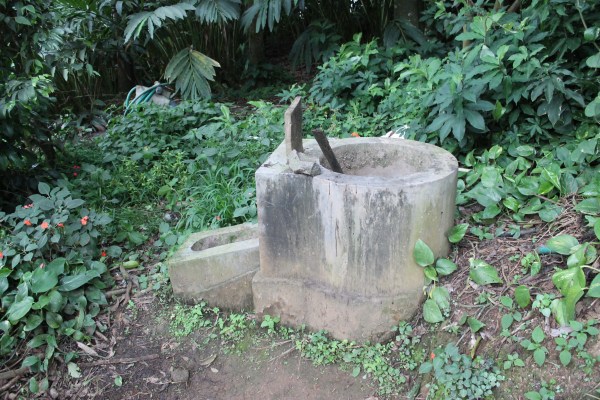
This story brings me back to my time in India, and the imaginative moment I experienced while in the humblest of environments. We were passing through the property of a cardamom-grower, en route to a scenic view point of neighboring Tamil Nadu, when we noticed a concrete structure, no more than three-feet tall, which we didn’t understand. After some probing and translating, we came to know that it’s called a gobar gas ‘plant.’ I provided a description of this type of plant in a post this summer, and documented my amazement with it then. But even though, when I read that post again today, I can sense the excitement I had while writing about it, I think I may have been too proud at that time to admit what I truly felt while researching gobar, and when I found that it’s used to power millions of homes in India and thousands more on the Indian subcontinent. What I felt most deeply was embarrassment; I was embarrassed that I could hardly understand how it worked, embarrassed that it was so amazing to me, embarrassed that my relationship with energy was so superficial, embarrassed that I was so blind. Being at once embarrassed and amazed gave rise to a tension, an uncanny feeling of being not-at-home, alienated from both the sleek invisibility of power in the U.S., and the concrete bulk of the gobar gas plant. But in this tension lay the possibility of something new—a synthesis. What I imagined was building a gobar gas plant of my own. I imagined learning about it and then doing it.*
Many of us who see splendor in the simplicity of the land, who are concerned about how human development affects the earth, have known for some time that it is not enough merely to ‘go Green.’ Like the Occupiers and the Egyptians in Tahrir Square, like the townsperson who needs water, we must learn not to turn only to the habitual, well-trodden paths of activism and protest. When a system is broken, sometimes it doesn’t do to fix it. Sometimes, you must put it aside and start anew. Sometimes, you must learn to dig your own well.
*As of publication, I haven’t done it (sometimes imagination only goes so far).
 Organikos
The protest is just a beginning of digging the well. It is part of process to get to the water.
Pingback: USA Refresher « Raxa Collective