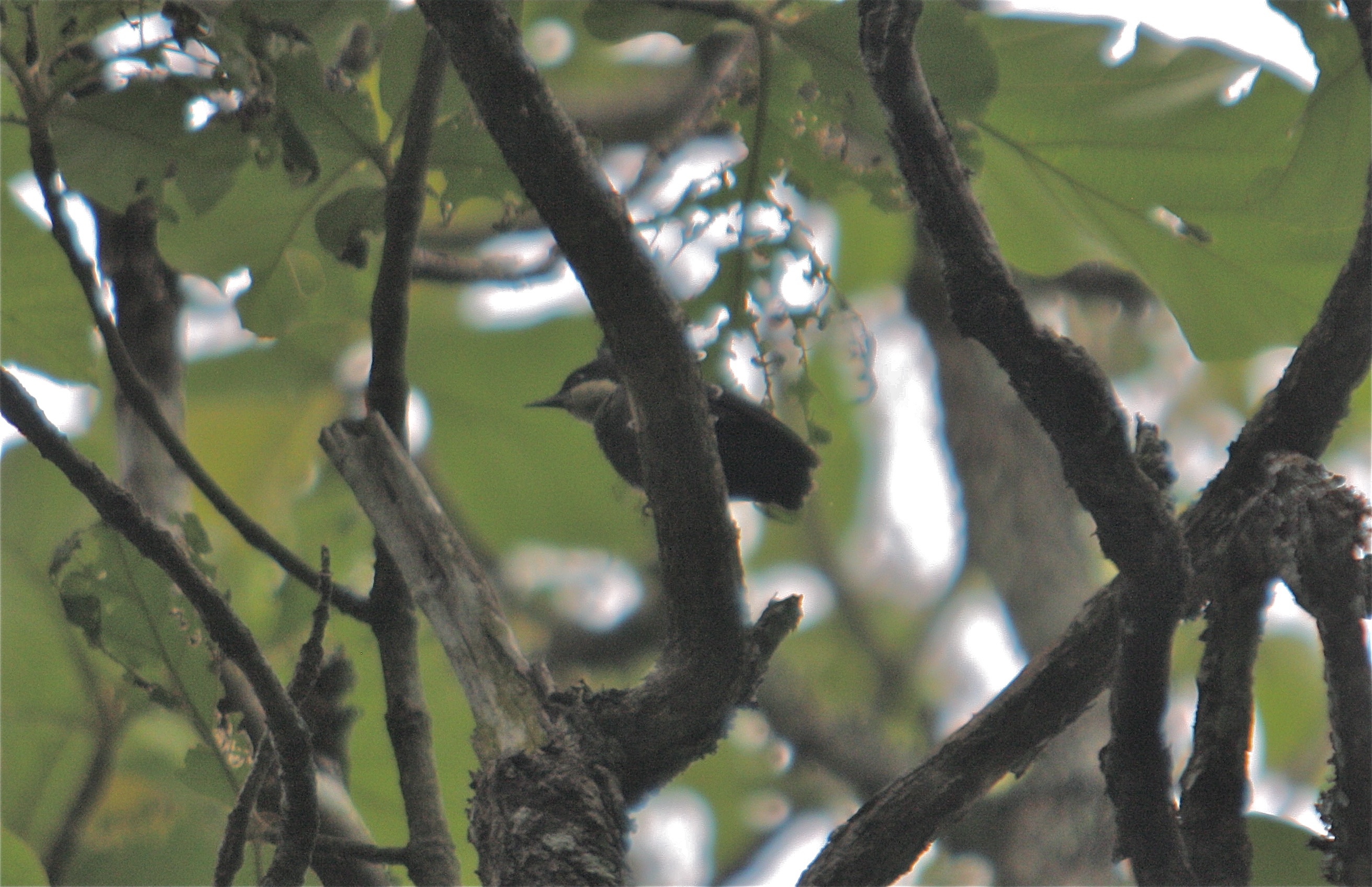
After trying for about half an hour to photograph this little Heart-spotted Woodpecker all I could manage was this photo! I’ll take it!!
Before embarking on a birding trip, I always attend to a few traditions. First, I get a bird book for the location to which I am traveling, a necessary step in order to familiarize myself with the birds of that region. When I am birding in the eastern United States, my guide of choice is Sibley’s Guide to Eastern Birds; likewise, when birding in the western United States, I choose its contemporary, Sibley’s Guide to Western Birds. However, when birding internationally, I have found that Princeton makes unbelievably good field guides for a tremendous variety of places. I purchased the Princeton Field Guide to the Birds of East Africa for my trip to Kenya, and for this most recent trip, the choice was easy – the Princeton Field Guide to the Birds of India (including Pakistan, Nepal, Bangladesh, Bhutan, Sri Lanka, and the Maldives).
I purchase and study my field guide long before the trip begins – although it does make for great reading on a long plane ride – so that I have plenty of time to become an expert (or as close to one as possible) in identifying the birds of that region even before the plane lands. One trick I have used for both Kenya and India is to mark the birds I have a reasonable chance of seeing. This way I narrow down the list of birds I need to study, making the task at hand that much easier. Using these tactics, I was so familiar with the field guide for my trip to Kenya that at times I could not remember the name of the bird, but I could recall what page it was on and what birds it was next to (it is funny how memory works sometimes). Another one of my techniques for learning new birds in a completely foreign location is to simplify the identification. For instance, say you are trying to learn how to identify the different Goldenback woodpeckers found in the Western Ghats. My first step is to have a broad idea of what I am looking for so that I can narrow down the bird to an identification as general as a Goldenback woodpecker. To further narrow the identification, I normally pick out one defining characteristic about each species that I can use for fast and reliable identification. For instance, the Common Goldenback has a complete post-ocular black stripe, the Lesser Goldenback has an incomplete post-ocular black stripe, the Greater Goldenback has much more black on the face than its family members, and the White-naped … Well, it is self explanatory; look for the white nape. Often you won’t get a very good look at the bird or as soon as you get your binoculars on it, it will fly away, much to your chagrin. Therefore, it is good to have something to quickly look for.
When following the traditions of buying and studying the bird guide, it is inevitable that certain birds will catch your eye. When looking through North America field guides, you might be drawn to the Elegant Trogon, Blackburnian Warbler, or Painted Bunting. When looking through African field guides, it is hard to ignore Ostrich and Secretary Bird, as well as the Lilac-breasted Roller. I am so taken with birds such as these that, for me at least, they become “must sees” for the trip. With a combination of knowledge, determination, and perseverance, I almost always find my target birds. Some of my target birds over the years have been Elegant Trogon, Red-faced Warbler, Whooping Crane, Altamira Oriole, Common Redpoll, Evening Grosbeak, Snail Kite, Mourning Warbler, Kirtland’s Warbler, Townsend’s Solitaire, Black-footed Albatross, Secretary Bird, and Common Hoopoe. Choosing target birds has become an exciting part of the trips for me.
When it came time to travel to Kerala where I would have the opportunity to bird in exciting places including the Periyar Tiger Reserve, I naturally had to have a set of target birds. Of course all of the birds in this part of the world are absolutely stunning, and even though I would love to see and enjoy all of them, I would do myself in if I had 323 target birds! So, I narrowed it down to four: Pheasant-tailed Jacana, Great Hornbill, Heart-spotted Woodpecker, and Asian Fairy-Bluebird. Secretly though, the one bird I wanted to see most was the Heart-spotted Woodpecker. At 16 cm, this bird is about the size of your fist, and in the air it looks like a flying rock. It is probably the most adorable bird I have ever seen in a book or in the wild. While flipping through the 1,375 species in my India book, it was this little woodpecker that captured my birder’s heart.
When I arrived in Kerala and more specifically at Cardamom County, I had several goals–reach 1,000 world birds, have fun, and see the Heart-spotted Woodpecker. Now to be honest, I am not the most patient birder; therefore, after two weeks and many birding excursions without spotting my little woodpecker, which the guides claimed was pretty common in the reserve, I was getting anxious. I had over 130 birds but none of my four; however, that was about to change.
One sunny afternoon here at Cardamom County, I decided to take photos of swifts from the roof of the restaurant. I was walking back and forth trying to capture photos of a Crested Treeswift when out of the bamboo groves flew a little plump bird with a distinct crest and black and white markings. I yelled out (to myself) HEART-SPOTTED WOODPECKER. To my own embarrassment, I started singing and dancing on the deck, which I am sure drew some confused looks, but I did not care. I immediately decided that this was my second favorite bird in the world, behind only Secretary Bird. I was thrilled, but my work was not finished. I needed a photo of my woodpecker, and I still had three more target birds to go.
The next day I decided to take a hike into the reserve, and what a day of birding it was! In a stretch of about ten minutes, I found an Asian Fairy-Bluebird, a flyover Great Hornbill, and six (count ’em – 6!) Heart-spotted Woodpeckers. I was even able to take a terrible photo of one of the woodpeckers–I have never worked harder for a picture. Needless to say, I enjoyed the birding that day, and I hope to see many more of these birds in my remaining eight weeks here. Since I have yet to see Pheasant-tailed Jacana, I cannot sit back and relax just yet, and believe me, you will know when I see it.
I have a love/hate relationship with choosing target birds. I hate it when I cannot find them, and I love it when I do. Regardless, I have a feeling I will keep all of these traditions–as long as I keep seeing the birds.
 Organikos
Now I’m waiting for a story about the Wal-Mart birds…………..lol
Pingback: Borneo, Birds And The Field Method Of Learning Science |