“Pick a nest.”
It was the first day of my architectural design studio class and we were told to pick a nest, any nest. I knew this was going to be a great semester: the first assignment was seemingly random, kooky, and just a little ‘out there.’ I was excited! As an architecture student, I love when things are approached in such a non-traditional way.
I know what you must be thinking: aren’t architects supposed to be designing buildings for people? Why are you looking at bird nests?!
I, too, was confused, but I didn’t question it because I had a really cool nest in mind. Because I spent the summer in India with bird-lover and birder extraordinaire, Ben Barkley, the Baya Weaver Bird, who builds its iconic hanging nests around the backwaters of Kerala, was an obvious choice.
Here are my “comprehensive drawings” of the Baya Weaver Bird that attempt to explain the complex relationships the bird maintains with its surroundings.
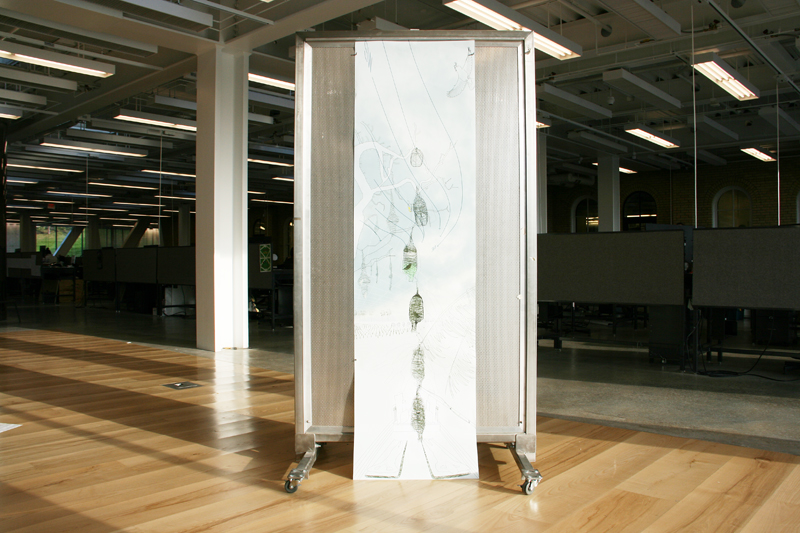
My 2nd draft of Baya Weaver nest comprehensive drawing (Photograph and drawing by Karen Chi-Chi Lin)

A male baya weaver adding the entrance shaft to his nest. The green entrance tunnel is only added after the male bird finds a mate. (Photo by Jugal Tiwari)

Typical nest anatomy showing the two chambers and the approximate dimensions (Sketch by Karen Chi-Chi Lin)

More of my research notes about the Baya Weaver Nest (Sketch by Karen Chi-Chi Lin)

Map of the South-West Monsoon that sweeps through South and South East Asian in the summer monsoon months from June to September. The Baya Weaver’s mating season is interwoven with its nest building season during the summer monsoon seasons. (Sketch by Karen Chi-Chi Lin)
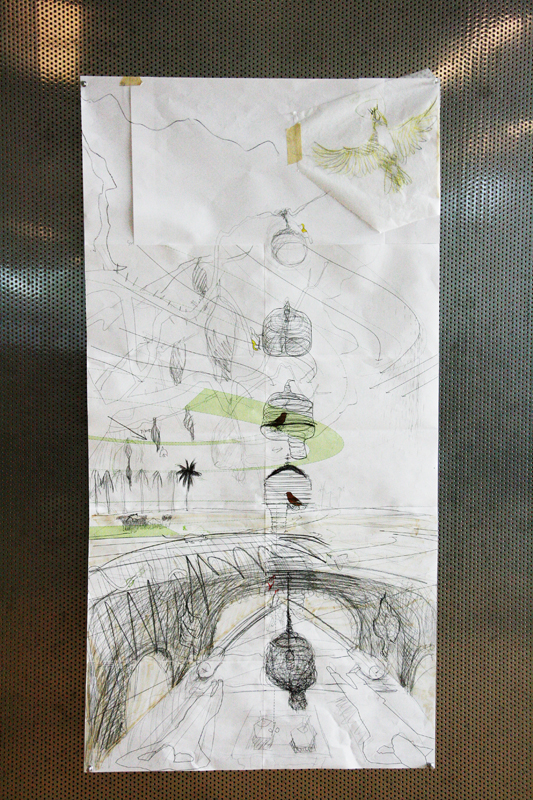
First draft of my “Baya Weaver Nest Comprehensive Drawing” (Drawing by Karen Chi-Chi Lin)
This illustration shows the different relationships the Baya Weaver’s environment has with the nest. Here are some of the “things” I wanted to explore through drawing:
Nest-building process: I showed the nest-building process from top to bottom. The anatomy of the nest is dissected and the viewer can see the two chambers of the nest in the nest that is under construction. The viewer can observe the brown birds are always the ones nesting inside, while the yellow bird is outside building the nest; from this, one can deduce that the male yellow-marked bird is the builder while the female brown-marked bird is only responsible for nesting.
Tourism’s role with the Baya Weaver nest: The Baya Weaver nest is often used as decorative lampshades or even stuffing for mats. The natural and organic materiality accents many tourists’ rooms or Kerala backwater boats.
South-West Monsoon season: the “Rainy Season” of South and South East Asia is named as such for the seasonal South-West monsoon. The arrows are directional and implies the seasonal weather.
Nearby rice paddies: On the left side, one can see farmers wearing umbrella hats (it’s Kerala!) working in the rice paddies. Because the Baya Weaver uses grasses from the tall rice plants and eats pests and grains, the Baya Weaver adjusts its mating rituals and schedule to the three major rice planting seasons in South Asia.
Predators! Can you spot the snake and rat climbing up along the palm frond? Baya Weavers tend to make their nests in palm trees or Acacia trees. Since the palm trees don’t have spikes like the Acacia trees, it is much easier for predators to access the nests.
“Failed” nests: Notice how each of the nests hang with its entrance tunnel to the right side, except for one. The one that hangs on the left side (West side, in relation to the directional arrows denoting the monsoon) will sway in the wind when the monsoon hits and the eggs will shoot right out of the tunnel.
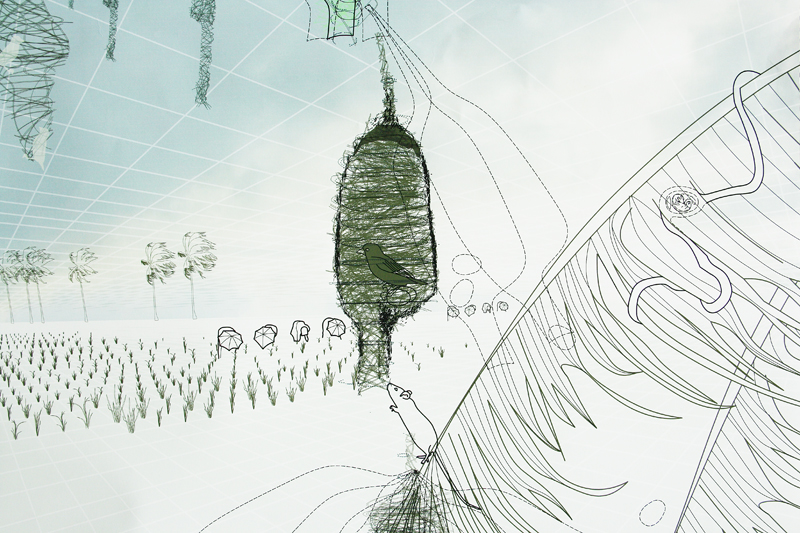
Detail of the 2nd draft of my drawing showing the predators and the failed nest with eggs tumbling out! You can see the rice paddies and farmers in the background. (Photograph and drawing by Karen Chi-Chi Lin)
I guess the question still lingers: aren’t architects supposed to be designing buildings for people? Why are you looking at bird nests?!
Here’s why: not only is the nest small enough for me to handle with my two hands, but the nest also acts as great metaphor for today’s American obsession with second housing. After all, it too is a small constructed home, no? And a bird sources its materials (like we humans do), builds it (we humans do that too), and sometimes maintain more than one (some humans have other nests for winter break). It’s a helpful little metaphor to explore the complex web of ecologies we live in or vacation in.
 Organikos
Pingback: Basket Cases | Raxa Collective
Pingback: little weaver bird get weaving | inquiline