
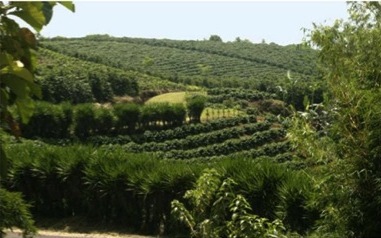
Coffee plantations surrounding Xandari, Costa Rica.
Photo: Emilia Ferreira
It is not a journal we regularly read, but the topics in this particular study–coffee and climate change–we follow closely. Click the banner above to read the (accessible to non-scientists) article:
Coffee (Coffea L.) is the world’s favourite beverage and the second-most traded commodity after oil. In 2009/10 coffee accounted for exports worth an estimated US$ 15.4 billion, when some 93.4 million bags were shipped, with total coffee sector employment estimated at about 26 million people in 52 producing countries [1]. Arabica coffee (Coffea arabica L.) and robusta coffee (C. canephora Pierre ex A.Froehner) are the two main species used in the production of coffee, although the former is by far the most significant, providing approximately 70% of commercial production [1]. The productivity (green bean yield) of Arabica is tightly linked to climatic variability, and is thus strongly influenced by natural climatic oscillations [2]. The stated optimum mean annual temperature range for Arabica is 18–21°C [3], or up to 24°C [4]. At temperatures above 23°C, development and ripening of fruits are accelerated, often leading to the loss of beverage quality [5], although in some locations higher temperatures (24–25°C) can still produce satisfactory yields of beans, such as in northeast Brazil [6]. Continuous exposure to temperatures as high as 30°C leads to stress, which is manifest as depressed growth and abnormalities, such as the yellowing of leaves and growth of tumours on the stem [7]. In regions with a mean annual temperature below 17–18°C growth is also depressed [8]. Occurrence of frosts, even if sporadic, may strongly limit the economic success of the crop [5]. The relationships between climatic parameters and agricultural production is further complicated because these environmental factors influence the growth and the development of the plants in different ways during the various growth stages of the coffee crop [2].
 Organikos