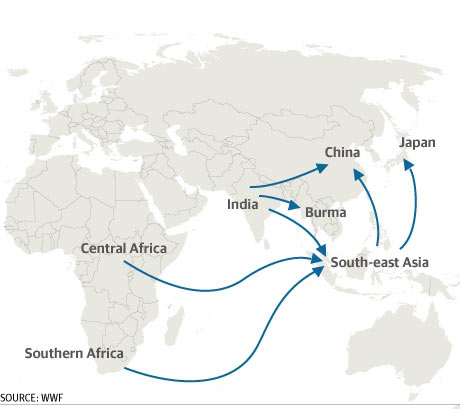
This earlier post touched on WWF’s use of military technology to take on an increasingly militaristic illicit trade. In today’s Guardian, an article with an insightful video embedded (click the map above) touches on approaches to disrupting these patterns. According to a new study commissioned by WWF and conducted by Dalberg, illegal wildlife trade is increasingly mapping on to the patterns of trade for illicit drugs and arms globally:
Organized crime syndicate members at levels 4 and 5 are often located in consumer countries, beyond the reach of enforcement authorities in range countries. For this reason, increased international cooperation is vital.
The problem is transnational and involves range, transit and destination states. A coordinated approach at both a national and an international level is required to ensure that the entire crime chain at all five levels of illicit wildlife trafficking is addressed.
In this regard the International Consortium on Combating Wildlife Crime (ICCWC) was created in 2010. ICCWC comprises the CITES Secretariat, INTERPOL, the United Nations Office on Drugs and Crime, the World Bank and the World Customs Organization, and it seeks to ensure that the perpetrators of serious wildlife crimes will face a more formidable and coordinated response.
Demand reduction is also important, and consumers need to be made aware of the impact of consuming illegal wildlife products and the associated destruction of the environment. This can be done through targeted consumer campaigns by governments and through civil society, supported by governments.


Pingback: Conservation Could | Raxa Collective
Pingback: Illegal Wildlife Trade, Quantified | Raxa Collective