Those of us living nomadic lives, moving from one set of responsibilities (or lack thereof) to another set in a different context, are often living by a compass we cannot quite figure out. A frequent first greeting in India, upon seeing someone who is clearly not from India, tends to be a variation on the question of where were you born. “Where do you stay?” (i.e. where is your residence at this moment) is the follow up to wondering where you are from. “Where are you going?” is rarely of concern. It seems understood by all that there may be no return to the place of birth, or the place where you stayed before, or other familiar places.
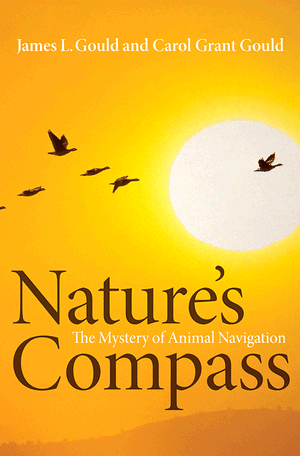
A new book surveys the animal kingdom for some remarkable examples of other creatures’ compasses. What about that cat that found its way 200 miles from an unknown location to the place where it normally lived? A review of the book in The Times Literary Supplement begins:
Curlews wing 6,000 miles, non-stop, along invisible bird-flying lanes in the sky as they travel from the South Pacific to Alaska. Spiny lobster crawl, one after the other, antennae to tail, for 30 miles along the ocean floor. Idaho salmon travel 900 miles and ascend 7,000 feet in elevation as they seek – and find – the tiny creek in which they hatched.
That our planet is alive with the movement of migrating animals is one message of Nature’s Compass by the ecologist James L. Gould and the science writer Carol Grant Gould. Another is that whenever we, Homo sapiens, swell with pride at our superior abilities, we might stop and think about how other animals migrate from place to place. Via the sun and the stars, using internal magnets and cognitive maps, animals travel long distances with fantastic precision. Many animals, say Gould and Gould, “are performing feats far beyond anything humans can manage without specialized instruments, equipment, and training”. The focus on the distinction between what is innate and what is dependent on experience puts a fresh perspective on the story of animal migration. Sandhoppers, tiny crustaceans that forage at the tideline at night, straight after birth make tracks directly towards the water based on inborn knowledge. If born on the north–south Atlantic coast of Spain, they hop west, but if born on the east–west Mediterranean coast of Spain, they hop south. If sandhopper mothers are plucked from the Atlantic shore and deposited on the Mediterranean, at birth their young will still hop west. However, despite setting off the wrong way, these disoriented newborn sandhoppers often do reach the water; they adjust their instinct-driven travel direction using environmental cues such as the slope of the land towards the shore….
Click the image of the book above to read the rest of the review. If this is your cup of tea, then definitely supplement your reading pleasure with this sonically rich podcast covering similar territory.
 Organikos
Pingback: Star-Led Little Critters « Raxa Collective
Pingback: More On Internal Compasses « Raxa Collective