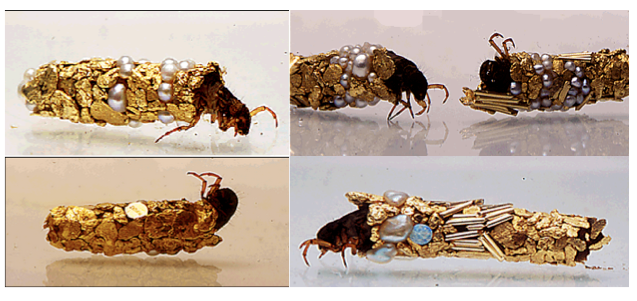
The caddis worm (order Trichoptera) may not be as popular as its famous shiny cousin, the scarab beetle, but it carries the extra charisma of an intrinsic aesthetic behavior.
French artist and science enthusiast Hubert Duprat took his natural curiosity to an elaborate level when he began providing these case building larva with gold spangles and semi-precious materials in lieu of the bits of sand and gravel they would normally use.
An amazing observation is that the worms seem to approach their work with an artistic eye, choosing the color and quality of the materials they use. In the 1930s an American entomologist observed in a Nevada river that “among all the little particles of sand and minerals swept along by the water, the Trichoptera make meaningful selections of bright blue opals—in other words, the most conspicuous or garish materials.”
Duprat collaborates artistically by placing luxury materials into the caddis worm’s environment. The larva connects the materials with silk thread using a spiral movement to make a tube, and then upholsters the inside of the case with a lining also made of silk. The resulting jewel encrusted creations are as ornate as many Fabergé eggs.
In addition to the artist’s video below, you can find an interview between Duprat and art critic/philosopher here.
(It should be noted that once the larva enters it’s nymph stage it abandons the case naturally, so no harm comes to the insect in this process.)
 Organikos
Very cool. I’ve studied various caddis species (Trichoptera) on the River Barrow in Ireland. We wanted to know if they were suffering due to the introduction of the invasive Asian clam. The cases produced by the caddis species are just stunning. The river contains an insane amount of a shiny substance I believe to be pyrite (it looks like gold but it’s quite brittle) and many of the caddis cases have incorporated material which has been coated in this mineral. They also make their cases with the opercula of aquatic molluscs as well as the shells of small gastropods. The variety of case designs I saw during my studies was very exciting and I spent an inordinate amount of time staring at them through a microscope.
That’s fantastic Rob. I read a lot about the species taking the mica and other interesting materials that occur naturally in the water too. It’s so interesting and yes, very cool! Thanks for your comment and for introducing yourself! Cheers.
Pingback: Metal, Craftily Crafted | Raxa Collective