Remarkably, a second article in the same issue of the New Yorker devoted to one of our favorite topics–the wonders of nature. Click the image above to go to the source. The first one we linked to is by one of the magazine’s most distinguished writers, and we are pleased to encounter the author of the following for the first time:
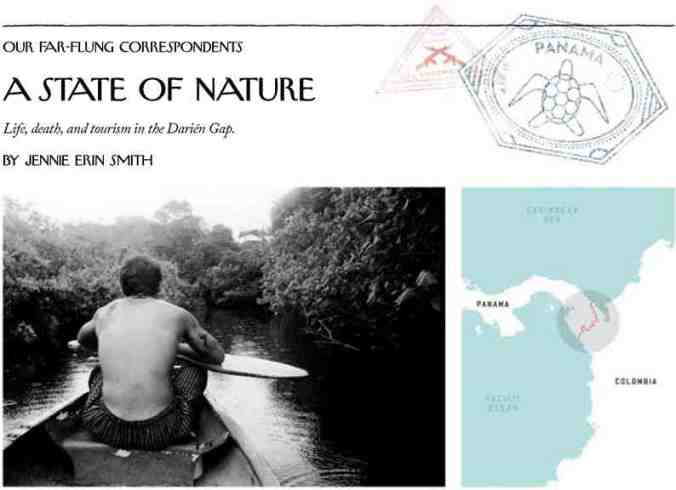
The Pan-American Highway runs sixteen thousand miles, from Anchorage to Tierra del Fuego, with one significant interruption: an expanse of rain forest along the border of Colombia and Panama. The road ends abruptly on the Panama side, just north of a national park, and picks up again as a dirt path, sixty miles southeast, in Colombia, in the floodplain of the enormous Atrato River. The region in between, which spans two coasts with jungles and mountains and a confounding web of rivers, is known locally as the Tapón del Darién—the Darién Plug—for its seeming impassability.
In English, it’s called the Darién Gap, the legacy of a nineteenth-century scramble to cut a seafaring channel from the Caribbean to the Pacific. The Prussian explorer Alexander von Humboldt speculated that the Darién isthmus harbored a river passage that need only be expanded to be navigable. In 1850, an Irish physician named Edward Cullen claimed to have walked such a passage without trouble, and his fraudulent assertion—supported by detailed phony maps—sparked a series of expeditions. Four years later, a twenty-seven-man team, led by Lieutenant Isaac Strain, of the United States Navy, set off to find Cullen’s mythical east-west passage. The team got lost within days and was forced to divide; seven men ultimately died. Strain refused to believe the indigenous Kuna who told him that he was going the wrong way, and months later he was found naked and sick, reduced to seventy-five pounds. He deemed Darién “utterly impracticable” for a canal, and engineers looked north to Panama City.
A century later, work stalled on the Darién link of the Pan-American Highway, and the gap came to mean something else: a breach in a road running north to south. American tourists arrived eager to hike it, and backpacking guides offered routes through the Serranía del Darién, the mountain range on the Colombia-Panama border. To automobile companies, the gap became an irresistible venue for publicity stunts. In 1961, a caravan of three red Chevrolet Corvairs took on “the world’s worst roadblock on the world’s greatest highway,” with support teams hacking trails and building bridges.
Read the whole article here (subscription required).
 Organikos
Pingback: Lost City Of The Monkey God | Raxa Collective