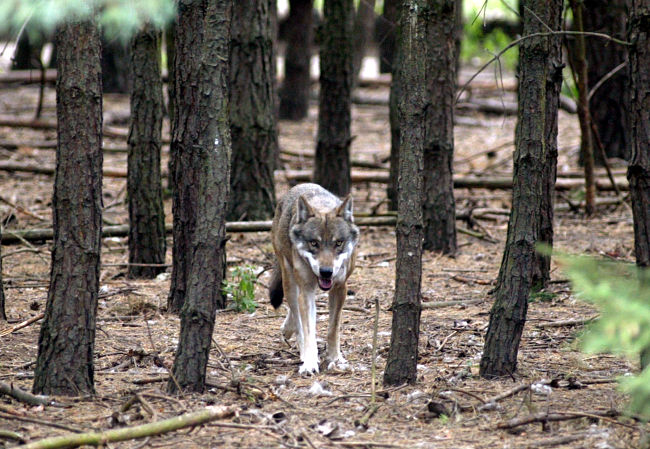
Thanks to the Atlantic Monthly‘s website for this story (click the image above to go to the source) about the resurgence of one of nature’s most historically feared beasts. Although the return of these animals has made relations between conservationists and farmers more difficult in Germany as elsewhere, the net gain for our natural world speaks for itself:
…Wolves have been absent from Germany for nearly a century, hunted out of existence by the end of the 1800s.
But over the past 10 years, they’ve made a comeback as packs from Poland and Russia have migrated into the sparsely populated eastern German state of Brandenburg. Today, some 160 wolves in 17 packs rove south and east of the capital Berlin, occasionally wandering into the city.
Their reemergence has not been without controversy. The wolves’ return has pitted conservationists against farmers, who are angry that the wolves are eating their sheep, other livestock, and sometimes even household pets.
“We’re not against wolves, but we want them to stay on government-owned lands. When they leave these territories, we want to be able to shoot them,” said Lutz-Uwe Kahn of the Brandenburg Farmers Alliance.
Wolves have killed some 360 sheep and other livestock since 2007. Though the state of Brandenburg has created a fund to compensate farmers for their livestock losses, Kahn said some members of his group have waited up to a year for reimbursement. Farmers have also encountered red tape when attempting to tap into a fund that supports the building of livestock pens and the training of sheep dogs.
Wolf expert Gesa Kluth of the Lausitz Wolf Office in Rietschen is a strong proponent of the wolf’s return to German soil. She hopes their comeback could mark the regeneration of an ecosystem that hasn’t existed in Europe for 200 years. But she is worried that old biases against wolves could kill them off again just as quickly as they’ve returned.
“Poland is an example we should follow,” Kluth said. “They are much more relaxed. They have about 700 wolves – an impressive number for this part of Europe – and the numbers are growing. They don’t want to hunt them. Rather, they are taking steps to protect their sheep and goats from wolves.”
Unlike North American wolves, which travel in larger packs in order to improve their hunting success, wolf packs in Germany usually consist of parents and offspring. When food is scarce, a mother wolf might venture into a small town and forage for food in garbage containers.
Several such incidents have been reported — and this has angered farmers like Lutz-Uwe Kahn, who are banned from shooting wolves on their own land because the wolves are on Germany’s endangered species list.
“The wolves aren’t dumb – they’re going to seek out the easiest places to find food. And they’ll start to feel more comfortable around people, lose their natural shyness, and attack people,” Kahn explained…
Read the whole story here.
 Organikos
Reblogged this on Ann Novek–With the Sky as the Ceiling and the Heart Outdoors.
Reblogged this on Sunnyace Reblog Collections.
Hi Sunnyace–good to see you! Thanks for the reblog. Have you visited the RAXA Collective facebook page? There are lots of great things happening there too. See you soon!