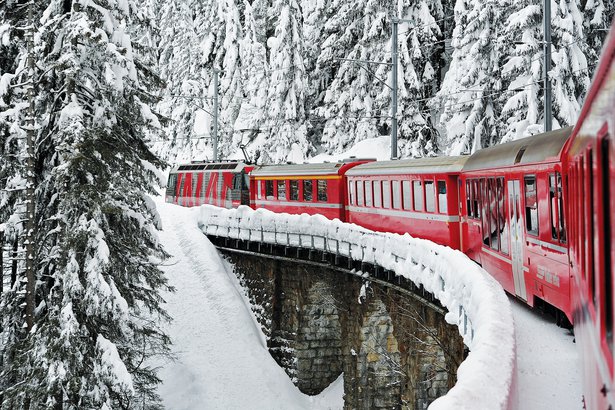
The snow-covered mountains and punctual trains of Montreux, Switzerland, summon childhood train sets, and the daydreams that accompanied them. (Harold Cunningham/Getty)
If we failed to get you reading him here, shame on us. If you choose to ignore this short piece of his, well, you have only yourself to answer to. He has had a running series of blog posts on the Atlantic‘s website dealing with the frustrations and wonders of language acquisition as an adult, a phenomenon several of us at Raxa Collective can relate to perfectly well. He captures some of the many benefits of the process and the outcome, especially the collaborative part, in short order here:
When I was about 6 years old, I started collecting model trains with my father. We would assemble the track in the attic, put a foam mountain with a tunnel over the top, and, through the magic of a transformer, watch the trains make their rounds. My dad took me to train shows, and for my birthdays back then, I always got train sets or trestles. I had books on model trains, and books on actual trains. Both kinds showed pictures of big mountains parted by trains, small towns bisected by trains, and trains adorning white Christmas-scapes.
It is from those books that I built an imagination and acquired my earliest notions of heaven—a highland where it snows often and when it doesn’t snow, it rains, where summer seems always in retreat. There is a big lake. Behind that lake is a mountain. Between the lake and the mountain, there is a village.
The village exists. Its name is Corseaux. It sits in the Riviera region of Switzerland, sandwiched between Lake Geneva and the Bernese Alps. I was there in April, reeling at how the postcards of my childhood fantasies had materialized into fact. On a clear day, across the still, black water, I could see France demarcated by white, snowy mountains. There was only one clear day. Clouds constantly threatened snow or rain.
Each day, I woke, washed, dressed, had a breakfast of bread and chocolate, and walked to the train station. The train’s punctuality strained the perceived limits of human engineering. So I was always on time, for I felt that to be here, among the real things, and stray from my appointed place was to abet some great evil. From the Corseaux-Cornalles station, I would train into Vevey and then transfer to another train to Montreux. I would then walk five minutes to the language school—the purpose of my visit—and the work would begin.
I started studying French in the summer of 2011, in the throes of a mid-30s crisis. I wanted to be young again. Once, imagination was crucial to me. The books filled with trains, the toy tracks and trestles—they were among my few escapes from a world bounded by my parents’ will. In those days, I could look at a map of some foreign place and tell you a story about how the people there looked, how they lived, what they ate for dinner, and the exotic beauty of the neighborhood girls.
When you have your own money, your own wheels, and the full ownership of your legs, your need for such imagination, or maybe your opportunity to exercise it, is reduced.
Read the remainder of the article here.
 Organikos
Reblogged this on ENGLISH LANGUAGE REVIEW 4U.
Hi Paul,
Thanks for introducing yourself with the reblog. You might also enjoy the RAXA Collective facebook page, we’re posting complementary items there. See you soon!
Pingback: In Praise of Slowness |