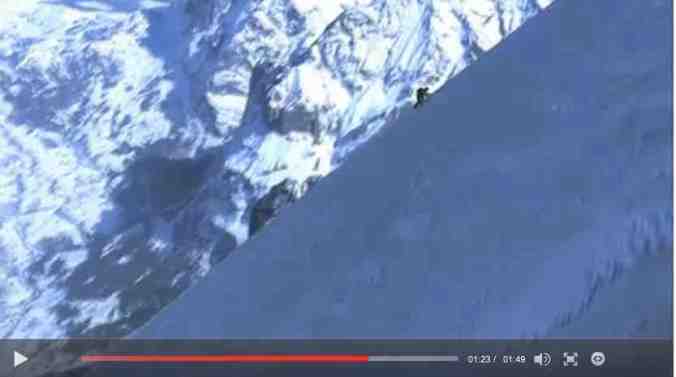
The article is worth the time, and the subscription, for reasons we pointed to here, here and here. Click above to go to this brief video for another enticement to read it and you will also see this additional wording from the author:
Many Americans got their first glimpse of Ueli Steck in the 2010 short film “The Swiss Machine,” which depicts Steck speed-climbing the North Face of the Eiger, as well as the Nose on El Capitan, in Yosemite. This short video consists of excerpts from that film. I approached Steck almost a year ago, in the hope he’d allow me to write a Profile of him, but he was hard to pin down. The media in Europe, where climbing is a big sport (Americans tend to consider it an esoteric and lunatic pursuit), keeps him busy enough, as does his brutal training regimen. Nonetheless, he finally agreed to see me in March, and told me secretly of his plans to put together a new route on Everest this spring. While I waited to see whether he’d succeed, the news came in from Nepal that Steck and his partners had been involved in a brawl with some Sherpas on Everest. The confrontation and its aftermath changed Steck’s life, and my story.
We looked around for more follow up on the conclusion to that story, and found this interview to be the most interesting and least sensational (though it is sensational) look at the clash of cultures that seems to be part of the story:
Renowned Swiss climber Ueli Steck – speaking to swissinfo.ch at Everest Base Camp – says he will not return to Everest, after Sherpas attacked him and his two climbing companions.
“My trust is gone. I could not go back to this mountain,” an emotionally shaken Steck said at Base Camp on Tuesday. In the interview, the Swiss mountaineer, best known for his speed climbing in the Alps and Himalaya, explains that the incident high on the world’s tallest mountain on Sunday was an expression of anger that had been growing for years. A “rift between two worlds”, as he describes it.
Steck also admits that his team’s actions after the first altercation with the rope-fixing Sherpas above Camp 2 may have provoked the local guides.
swissinfo: What exactly happened up there? Why did you get attacked?
Ueli Steck: Well, this is an answer I am still looking for. I don’t think it was a personal problem towards our team but a long-term problem that has been growing in Nepal recently. I guess we were just at the wrong place at the wrong time. It started off as a verbal fight on the mountain, just below Camp 3 and when we came back to Camp 2 there were about 100 Sherpas trying to attack us.
swissinfo: According to the media and the Sherpas, you were also inconsiderate having climbed ahead of them while they were fixing the ropes. Do you think this was a problem?
U.S.: No, I don’t think it was a problem up there. We know they were fixing the lines and we were not touching their lines and we did not interfere. They were fixing the ropes for the commercial expeditions and not for us because we don’t need it. Of course, we have to leave space for everyone on the mountain. So we went 50m to the left so we would not disturb them and we were really careful not to knock any ice down. We did not disturb them at all. I think the fact that we were going up there made them angry because they were thinking that if they [the Sherpas] are on the mountain, nobody else can be on the mountain and that was the big problem.
swissinfo: Did you communicate with them while you were on the mountain? Or did you even overtake them on the Lhotse Face? Maybe they didn’t like that.
U.S.: They had been fixing the whole morning and we overtook them in about one hour. I can understand that this creates some problems or jealousy. But we certainly had no effect on their work at all.
swissinfo: What happened when you got back down to Camp 2?
U.S.: First of all, at Camp 3 we had to traverse to our tent at around 7,100m and at that moment we had to cross them, however, we did so very carefully. As soon as we reached the fixing point (belay) they were just shouting at us and there was no point in having a discussion. They were very upset. They dropped the loads and said they were done with fixing and went down. So we felt very bad for the commercial expeditions as these guys were working for them and they should finish the job and fix all the way to Camp 3. So we decided to finish the job and fix the rest of the way.
Even though we wanted to stay at Camp 3 to acclimatise that night we decided to go to Camp 2 to solve this problem and speak to them.
swissinfo: How did the Sherpas feel about you finishing their job? Maybe that upset them?
U.S.: In hindsight I think it probably upset them but at the moment we felt guilty for being responsible for them having stopped their work for commercial expeditions. That is why we finished their work. But maybe it made things worse. So we went down to Camp 2 and whatever happened there was unacceptable. There was no reason to try and kill three people – never anywhere in life or anywhere on the mountain.
swissinfo: Did they seriously threaten to kill you?
U.S.: This is what they said. The situation got out of control and nobody had any power to stop them. It was just a mob of 100 people hitting us with rocks and they threatened to kill us.
swissinfo: How did you protect yourself?
U.S.: The female American climber, Melissa Arnot, saved my life. She intervened when I got hit because there is no point in fighting back if you have 100 people against you. The only thing you can do is take the beating. Simone and Jonathan managed to run away but I was not fast enough (I am getting slow and old). I was in a tent and I was alone. The discussion outside the tent went on for about one hour and Melissa and Greg of IMG [International Mountain Guides] tried to calm them down but all I could hear was them shouting “Give us the guy. We will kill him first and then the other two”. Somehow they managed to calm them down. Simone had to apologise on his knees for his bad words on the mountain. So they gave us one hour to leave the mountain and told us never to come back again.
swissinfo: Did you abandon your expedition because the Sherpas told you to leave or was this whole incident reason enough for you to leave?
U.S.: If there are 100 people telling you that they are going to kill you and if among these 100 people there are a few you summited Everest together with last year and they were friends, it is hard to stay. I am so disappointed and my trust is gone. I could not go back to this mountain, even though everyone says that this would not happen again. I could not go back. Who can assure me that the angry mob is not cutting my rope or burning my tent?…
Read the rest of the interview here, and you can listen to a podcast interview with Ueli Steck (about 17 minutes, in English) from the same site.
 Organikos
Pingback: Steck Back Big |
Pingback: Sorry To Have Missed It | Raxa Collective
Pingback: Friends And Awesome Accomplishment | Raxa Collective