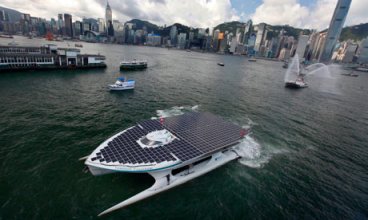
MS Türanor SolarPlanet will measure emissions in the open ocean. Photograph: Alex Hofford/EPA
The Guardian is reporting on a floating phenomenon worth a look if you want to peer into the future of climate change science:
The solar-powered boat docked in Battery Park City in New York could easily have been packed off to a museum as a relic.
The MS Türanor SolarPlanet saw its glory days last year, when the catamaran went around the world powered only by the sun and energy stored in the huge battery packs in each pontoon.
Now the 102-ft craft has embarked on a new life as a research vessel for a team of scientists from the University of Geneva studying the Gulf Stream under climate change.
The Swiss research team departs from New York on Friday for Boston, St John’s Newfoundland, Reyjavik, Iceland and Bergen, Norway to study the ocean current’s response to the warming of the atmosphere.
“We know very little about what is taking place over the ocean,” said Prof Martin Benitson who heads the institute for environmental research at the University of Geneva.
One big plus offered by the Türanor: the boat produces no emissions. Bentison said that zero emissions status means scientists for the first time will be able to collect data free of polluting substances, such as diesel fuel.
“Once we start measuring emissions in the open ocean, we can be almost 100% certain that these are ocean emissions, and not biased by a ship’s chimney,” he said.
The team will be collecting data from air and water to study the Gulf Stream’s response to climate change. The powerful ocean current carries water from the tropics up to the polar reaches of the Atlantic, taking the edge off winter temperatures in northern and western Europe.
Benitson and his crew will be harvesting data on aerosols, tiny, airborne particles, over the ocean, as well as phytoplankton, the microscopic, plant-like animals that are at the bottom of the ocean food chain.
They will also take a look at ocean eddies, the whirlpools that break off from the main current carrying large amounts of energy.
Scientists believe slowing of the Gulf Stream under climate change could bring colder conditions to Europe.
Projected changes in the Gulf Stream could also produce more intense hurricanes along the east coast of the United States.
“Sandy might not have been a one off, but something that might repeat itself two or three times in a decade.” Benitson said.
The research voyage offers a new lease of life for a ship that has outlasted its original purpose, said Gérard d’Aboville, the French captain.
Read the rest of the story here.
 Organikos