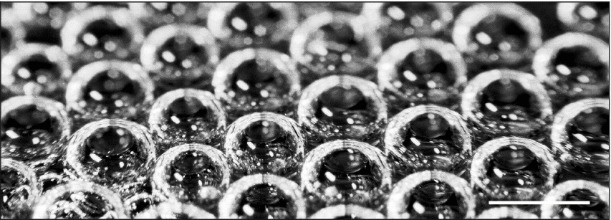
Bubbles at the surface of a freshly poured flute of champagne. Photograph by Gérard Liger-Belair.
Champagne is associated with celebration for many reasons, and having just learned that one of our former interns is planning a wedding we could not resist sharing this information in the spirit of citizen science-sharing (click the image above to go to the source in Scientific American‘s website):
…In Uncorked: The Science of Champagne, recently revised and translated into English, physicist Gerard Liger-Belair explains the history, science and art of the wine. His book also features high-speed photography of champagne bubbles in action and stop-motion photography of the exact moment a cork pops (potentially at a speed of 31 miles per hour (!). Such technology allows Liger-Belair to pair the sommelier with the scientist. “Champagne making is indeed a three-century-old art, but it can obviously benefit from the latest advances in science,” he says…
…Europeans, though, once considered the bubbling beverage a product of poor winemaking. In the late 1400s, temperatures plunged suddenly on the continent, freezing many of the continent’s lakes and rivers, including the Thames River and the canals of Venice. The monks of the Abbey of Hautvillers in Champagne, where high-altitude made it possible to grow top quality grapes, were already hard at work creating reds and whites. The cold temporarily halted fermentation, the process by which wine is made. When spring arrived with warmer temperatures, the budding spirits began to ferment again. This produced an excess of carbon dioxide inside wine bottles, giving the liquid inside a fizzy quality.
In 1668, the Catholic Church called upon a monk by the name of Dom Pierre Pérignon to finally control the situation. The rebellious wine was so fizzy that bottles kept exploding in the cellar, and Dom Pérignon was tasked with staving off a second round of fermentation.
In time, however, tastes changed, starting with the Royal Court at Versailles. By the end of the 17th century, Dom Pérignon was asked to reverse everything he was doing and focus on making champagne even bubblier. Although historical records show that a British doctor developed a recipe for champagne six years before Pérignon began his work, Pérignon would come to be known as the father of champagne thanks to his blending techniques. The process he developed, known as the French Method, incorporated the weather-induced “oops” moment that first created champagne—and it’s how champagne is made today.
Read the whole post here. Best wedding wishes from all of us at Raxa Collective.
 Organikos
Reblogged this on Beatz kane Blog.