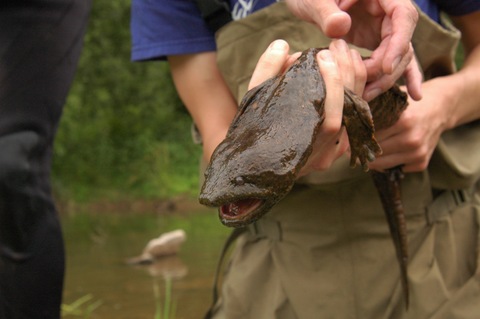
Matt Neff from the Smithsonian’s National Zoo holds a hellbender salamander that he caught in the Blue Ridge mountains of Virginia. Scientists hope to learn how healthy and viable the population is. Photo by Rebecca Jacobson
Thanks to the Public Broadcasting System of the USA for this story segment as their Science Wednesday feature this week:
…At the end of a long day snorkeling in the clear streams of southwestern Virginia’s Blue Ridge Mountains, Terrell and her team assumed their positions. As three scientists lifted a flat, heavy rock, Terrell groped underneath the stone, let out a muffled cry through her snorkel mask and popped out of the water.
“Where did it go? Did you see it?”
The biologists checked their nets and scoured the water. Sarah Colletti from the Aquatic Wildlife Conservation Center pointed at the slick rocks under the water. “Right there, he’s looking right at you.” One of the biologists lunged, secured a firm grasp, and triumphantly pulled it out: a nearly two-foot long hellbender.
Hellbender salamanders are long, flat, slippery amphibians that live underwater in clear mountain streams, under rocks that can weigh up to 1,800 pounds. Their coloring is a mottled green-brown that blends into the river bottom; they have wide flat heads, beady eyes and stubby toes.
While they’ve been around for 170 million years, scientists know little about them. There has never been a comprehensive national survey. Biologists surveyed areas in the past, but pinning down the exact size and territory of the population is tricky, said J.D. Kleopfer, a herpetologist from the Virginia Department of Game and Inland Fisheries, who is helping Terrell locate hellbender salamanders in the state. (He calls them “snot otters,” affectionately.)…
…Hellbenders are a “canary in the coal mine” species, meaning their health is an indicator for the health of the water quality and environment around them, Terrell says. As a completely aquatic species, they breathe through their skin, which makes them highly susceptible to any pollutants in the water. Runoff from agriculture, mining and energy development sends silt and pollution into their streams, choking the salamanders and causing them to disappear from once populous habitats. The salamanders appear to have vanished from once-reported habitats in Ohio and Illinois, for example. Their numbers have reportedly dropped so low in the Ozarks that the Arkansas and Missouri subspecies was listed as endangered in 2011…
Read the whole story here.
 Organikos
I think the 1,800lb tidbit is off, but what a cool creature!
Hi Isaac, you may be right, although I doubt they’re referring to the rock they lifted to grab this guy. We’ve certainly seen slab rocks in river gorges that could weigh close to a ton, so my assumption is that the author is describing that habitat. And cool indeed!
Pingback: Hellbender salamanders back in New York | Dear Kitty. Some blog