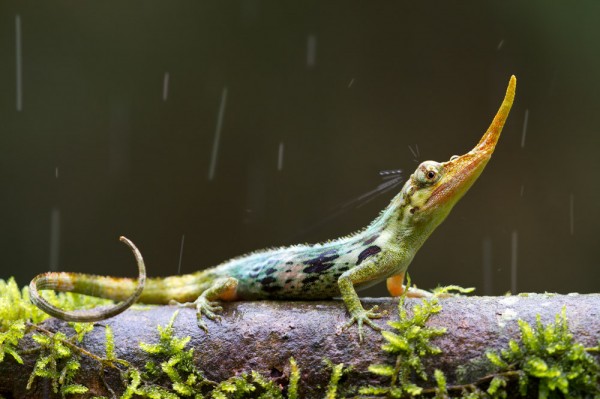
The lizard’s superschnoz on display. Photograph by Alejandro Arteaga, tropicalherping.com
News from Ecuador in recent weeks was mostly a bummer, environmentally speaking. The government there knew it was sitting on a gusher; specifically an extremely sensitive, biodiversity hotspot is sitting on that gusher; and they tried their best to offer the world an opportunity to help them avoid drilling. Did they do everything conceivable before deciding to drill? There is lots of opinion on that; no matter who is right, the outcome is not a good one. But let’s not throw the baby out with the bathwater. This week, however, there is news out of Ecuador that brings a smile to the face:
It’s no lie—scientists have spotted a lizard with a nose like Pinocchio in an Ecuadorian cloud forest. What’s more, the long-nosed reptile was thought extinct, having been seen only a few times in the past 15 years.
“It’s hard to describe the feelings of finding this lizard. Finding the Pinocchio anole was like discovering a secret, a deeply held secret. We conceived it for years to be a mythological creature,” Alejandro Arteaga, a photographer and one of the lizard’s spotters, said in a statement.
Not surprisingly, the defining feature of the Pinocchio lizard—properly named Anolis proboscis, or the horned anole—is the male’s long protrusion on the end of its nose. Far from being a sturdy, rigid structure, researchers have found that the horn is actually quite flexible. (See a picture of a Pinocchio frog found in Indonesia.)
Despite its peculiar appearance, the reptile wasn’t formally described by scientists until 1953. They managed to save only six specimens, all of which were male. It was spotted several times in the next few years, all near the town of Mindo, Ecuador (map), and then the species seemed to vanish…
Read the whole story here.

