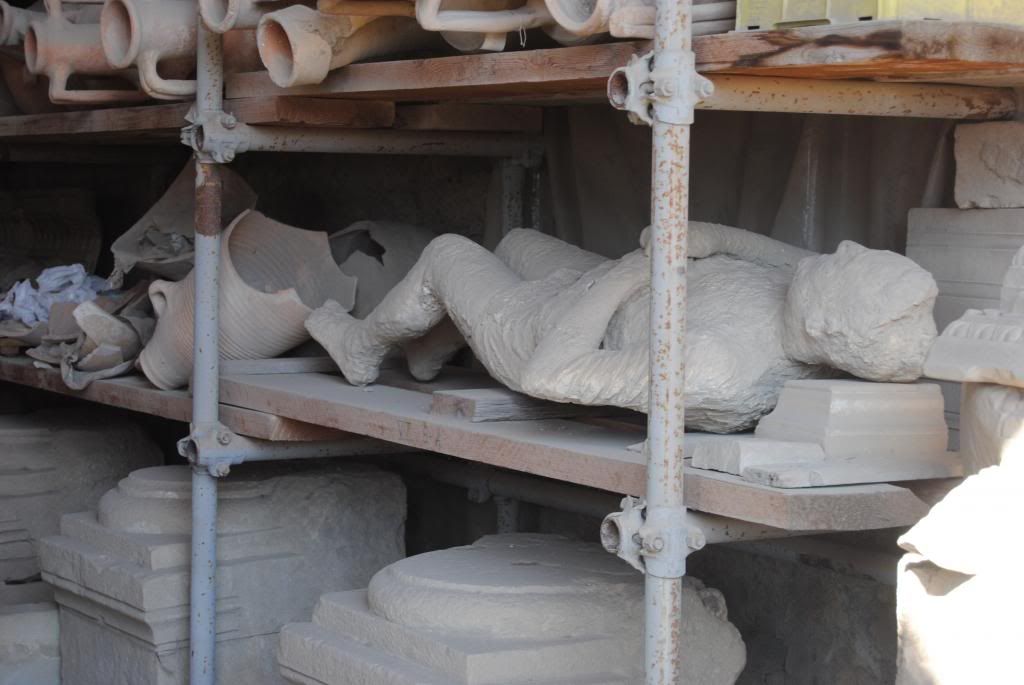
Encased in Ash – Body Mold from Pompeii
In 79AD, Mt. Vesuvius erupted with disastrous consequences for the residents of nearby Pompeii, Herculaneum, and other cities in the Campania region. Flows of boiling mud and rock rushed down the slopes, clouds of noxious fumes billowed upwards in the wind, and thousands of tons of rock and ash rained down upon the countryside. Pliny the Younger saw the eruption and likened it to a pinus, a pine tree. This may baffle some American readers, who may be accustomed to see pine trees that taper from a wide base to a narrow point; the Roman pine, however, which Pliny had in mind, looks like the proverbial “mushroom cloud” that comes to mind when we think of massive explosions.
This eruption is responsible for preserving an enormous amount of archaeological evidence, effectively giving us a snapshot of the Roman Empire in its heyday (at least in a few of the cities in the Italic peninsula). The falling stone and ash and the flows of mud and rock embalmed the cities—and the unlucky inhabitants too, in many cases. Most citizens died from roof collapses caused by the falling ejecta or the trauma and heat of the enormous waves of pyroclastic flow.
I have a few pictures here capturing the last (sometimes agonized) moments of these Romans. The bones (below) are from Herculaneum. (These are not the originals, which still exist, but have been moved.) The gray cast (above) was originally only a gap in the accumulated rubble where the organic material of a body had decayed and left behind a hole: modern archaeologists poured casting material in to form the impression. The poor dog (below) was a victim of pyroclastic flows.
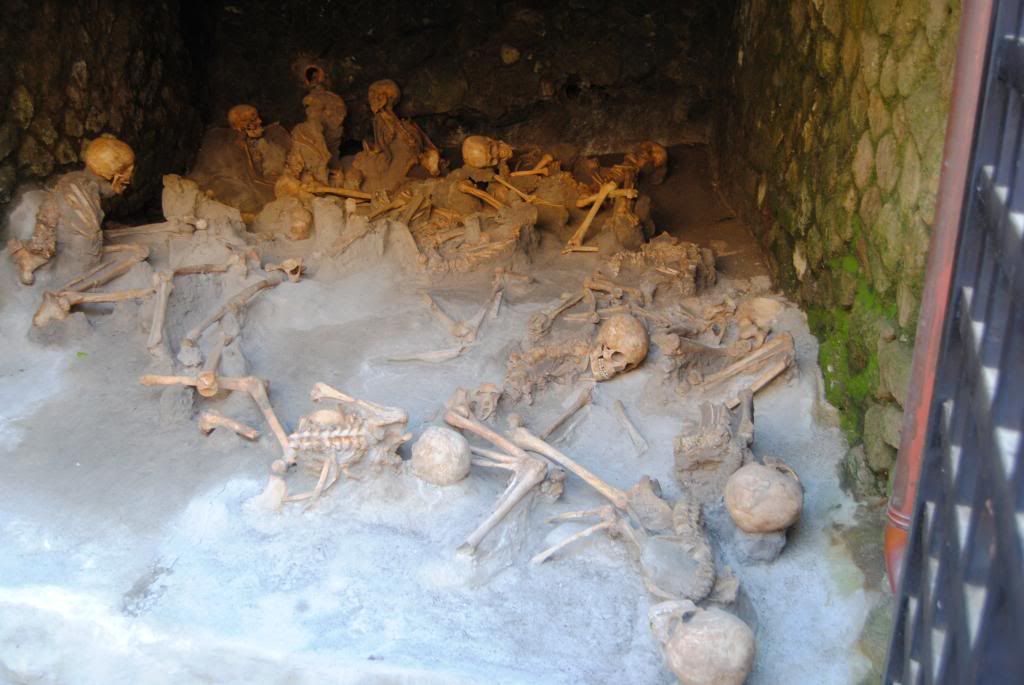
Herculaneum – Skeletons
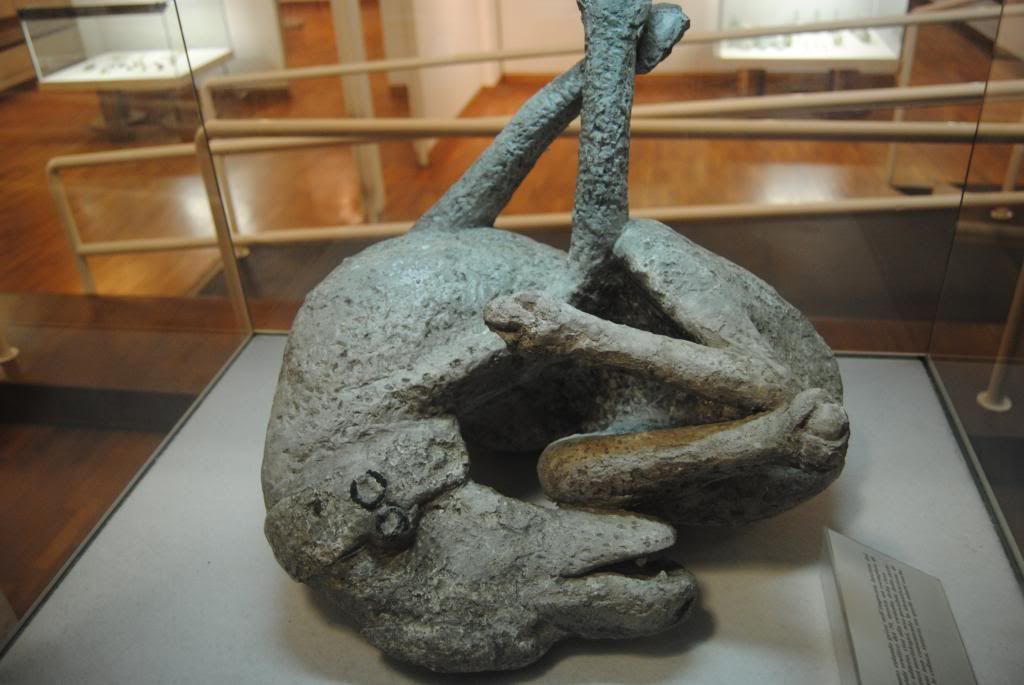
Dog – Campania
 Organikos