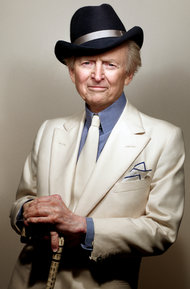
Mark Seliger/Little, Brown and Company, via Associated Press
When we read a great book, we get transported into a world of the author’s creation. We are not expected, nor do we normally want, to think about what went into that creation. Literary critics, perhaps, but not we lay readers. One exception to this general rule is when a writer comes along and changes things with his or her style of writing. Then, we might be curious about the craft itself. We have posted on this topic from time to time for various reasons related to Raxa Collective’s commitment to written documentation of our experiences. Today, one such craftsman has decided to share his craft (at a wow price, for both him and the recipient, we note). A few excerpts about this news as reported in the New York Times:
…But now, Mr. Wolfe is about to be enshrined in one of the city’s most august institutions, thanks to the sale of his archives to the New York Public Library.
The $2.15 million acquisition, largely paid for with a private donation, was approved by the library’s board on Wednesday afternoon. It will add significantly to the library’s holdings not just in American literature but in the history of New York City as well, said Anthony W. Marx, the library’s president and chief executive…
…Mr. Wolfe is credited with inventing the New Journalism in the 1960s, when, hard against a deadline for an article about California’s custom-car scene for Esquire, he sent his unvarnished notes to his editor at the magazine, which printed them pretty much as they were in 1964, under the title “There Goes (Varoom! Varoom!) That Kandy-Kolored (Thphhhhhh!) Tangerine-Flake Streamline Baby (Rahghhh!) Around the Bend (Brummmmmmmmmmmmmmm)…”…
…The archive also includes interviews with historically significant figures like the test pilot Chuck Yeager, featured in “The Right Stuff” (1979), that didn’t make it into the finished book.
“The collection has a double richness,” said William Stingone, the library’s assistant director for archives and manuscripts. “It will allow research not just into Wolfe as an innovator in style and methodology, but also into the things he did research into. He had access that people will never have again.”
The archive also contains something that future writers will be producing less of — book drafts composed on a typewriter or by hand. (Mr. Wolfe does not use a computer.)
Currently in storage in Mr. Wolfe’s apartment building on the Upper East Side of Manhattan, the collection will be opened to researchers after processing, probably by next summer, the library said.
“I feel like I’m not parting with it,” Mr. Wolfe said. “After all, it will be just down the street.”
Read the whole article here.
 Organikos