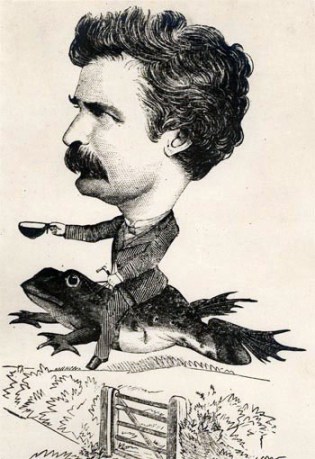
An essay published today in Lapham’s Quarterly reminds us of one man’s contribution to the travel writing genre in a previous century, in comic form but with clear hints at important cultural issues related to travel. The main theme of the essay, which is that not all writing important at a given moment in time travels well over time, is a humbling one considering the writer who is the subject of the essay:
On November 18, 1865, the New York Saturday Press published a short sketch called “Jim Smiley and His Jumping Frog” about a frog-jumping contest in rural California. It “set all New York in a roar,” reported one journalist, and soon went viral, reprinted in papers from San Francisco to Memphis. The story’s author was Mark Twain, the pseudonym of a twenty-nine-year-old writer born Samuel Clemens. At the time, Twain was living in California, enjoying provincial renown as a Western humorist. The success of “Jim Smiley” made him nationally famous. “No reputation was ever more rapidly won,” observed theNew York Tribune.
Twain’s stature quickly grew. Within a decade, he would publish his bestselling book The Innocents Abroad, perform to sold-out audiences at home and overseas, and build a mansion in Hartford, Connecticut, staffed with servants and outfitted with indulgences like a telephone, a billiard table, and a battery-powered burglar alarm. By the time of his death in 1910, he had become a legend—“the Lincoln of our literature,” in the words of Twain’s friend the author and critic William Dean Howells—and in the century since, he has been hailed by Ernest Hemingway, William Faulkner, and Norman Mailer as the father of modern American fiction.
“Jim Smiley,” subsequently retitled “The Celebrated Jumping Frog of Calaveras County,” lifted Twain to fame and laid the foundation for his later triumphs, but it isn’t especially funny anymore. What once made bankers in New York and boatmen in Baton Rouge laugh out loud would now at best elicit a halfhearted chuckle from a generous reader. It’s hard to say exactly why. Humor eludes elaborate theorizing, but it usually relies on context: on shared assumptions about the permissible and the taboo, the familiar and the strange. Some humor stays funny because its underlying truths remain in force—the flirty banter in The Taming of the Shrew, for instance, or the dick jokes inTristram Shandy. A large part of the pleasure in laughing at old material is realizing how little has changed. Other humor, by contrast, loses its power as its context fades.
“Jim Smiley” drew upon a context that has changed beyond recognition: the American West. More than just a place, the West was an idea; it spawned national legends, bestselling authors, and a menagerie of pop-culture entertainments, from the nineteenth century “horse operas” performed on Broadway to the dime novels featuring frontier outlaws. What made “Jim Smiley” such a hit was Twain’s upending of the conventions of this world, with a picture of the West at once recognizable and not.
The precise boundaries of the West were constantly changing, but the term always referred to the place where white men ran up against an alien continent. This collision destroyed native populations. It also created new myths and metaphors and slang, and the makings of a national identity. In 1750, the inhabitants of colonial America numbered little more than a million, and the West was the wilderness beyond the Allegheny Mountains. By 1850, the United States was home to twenty-three million people, and the West stretched all the way to the Pacific Ocean. The hunters and homesteaders who ventured into Ohio and Oregon didn’t simply transform the wilderness. They were themselves transformed by an unfamiliar, unforgiving landscape.
To survive, they had to adapt. For hordes of westward-bound whites from the colonial era onward, this was a delicate task. Eastern elites viewed the West with suspicion and scorn, a lawless backwater of heathen Indians and howling wilderness. Settlers ran the risk of losing their manners. In his Letters from an American Farmer, published in 1782, J. Hector St. John de Crévecoeur described frontiersmen as “a mongrel breed, half civilized, half savage,” and the prejudice remained firm into the nineteenth century…
Read the whole essay here.
 Organikos
Pingback: The Shifting Sands Of Relevance | Nature Conser...
Loved this post! Thanks for sharing – I wouldn’t have spotted the essay otherwise.
Keep up the good work.
All the best,
Ofglassandbooks