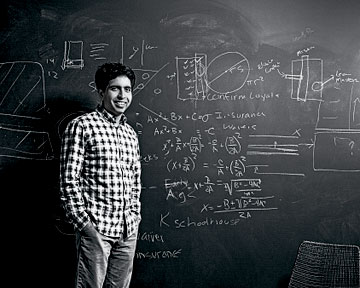
Harvard Business Review offers this interview with the founder of Khan Academy, a non-profit educational initiative that has been succeeding the way many dot-com businesses succeed–the difference being that all the benefits accrue to students and their educational attainment around the world. Bravo, Mr. Khan:
…In the traditional academic model, you’re passive. You sit in a chair, and the teacher tries to project knowledge at you; some of it sticks, some of it doesn’t. That’s not an effective way to learn. Worse, it creates a mind-set of “you need to teach me,” so when you’re on your own, you think, “I can’t learn.” Anyone in any industry will tell you there’s new stuff to learn every week these days. So you have to say, “What information and people do I have at my disposal? What questions do I need to ask? How do I gauge whether I’ve really understood it?” Khan Academy is designed to give students that agency. If you want to get more tangible, I would say learn how to program a computer, more about the law, and definitely statistics…
…Curiosity is a hard thing to squash, but the traditional model of education manages pretty well: Listen to lectures, take notes, feed back what you learned, and then forget it all. You’re not allowed to go beyond the curriculum. Khan Academy is all about giving more breathing room. You want to go deep? Go deep. I had this to some degree at the public school I went to in Louisiana, where there were gifted programs. Every day, starting in second grade, they took me out of class for an hour, and I would go to another room, with a mixed age group. The first time I went, I thought it was the biggest racket. I walked up to Miss Rouselle’s desk, and she asked, “What do you like to do?” I was like, I’m seven years old—shouldn’t you be telling me what to do? But I said, “I like to draw. I like puzzles.” She said, “OK, have you used oil paints? Have you done Mind Benders?” Soon I looked forward to that hour more than I did to spending the night at my friend’s house. And I learned more that applies to what I do today than in the five other hours of the day combined.
That’s what we need to create space for. Historically, it was hard to do in a scalable way. How do you personalize education for 30 kids without breaking the bank? But technology can deliver information at a student’s pace, give practice problems and feedback, and arm teachers with data, so that when students go into a classroom, it’s much more like what I experienced in that gifted program…
Read the whole interview here.
 Organikos
Reblogged this on My Blog.