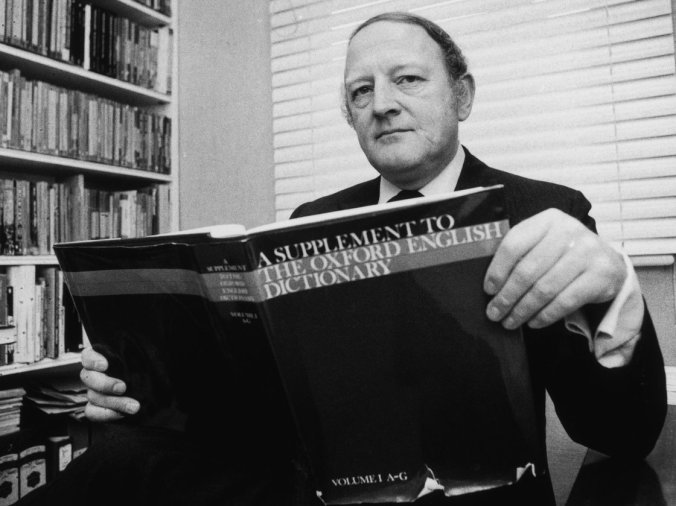
English writer and broadcaster Robert Robinson holding the first volume of A Supplement To The Oxford English Dictionary in 1977. Evening Standard/Hulton Archive/Getty Images
We love dictionaries, but apart from the Scrabble usage, we do not always know why. Thanks to Alva Noe for these clues (click the image above to go to the story on NPR’s Cosmos & Culture website):
Among the clutter and furniture of our intellectual lives, there are dictionaries. Although they have probably disappeared from the bookshelves of most college students, they haven’t disappeared. They’ve migrated online.
I thought of this while reading an article in The New York Times on the truly Herculean labors going on at the offices of the Oxford English Dictionary, where a team of scholars are busy producing the OED’s third edition. They started in 1994 and now anticipate finishing in 2037. It’s going to be a long book, if it ever comes out in book form. The second edition, published in 1989, was nearly 22,000 pages. (As reported in The New York Times.)
But when you stop to think about it, there is something strange about dictionaries. Why do we need them?
Bilingual dictionaries tell us what foreign words mean; they explain the unfamiliar in terms of the familiar. The first dictionaries were two-language of this sort. But what use is there for amono-lingual dictionary?
After all, we already know what our own words mean. We use them all the time. Sure, there may be the odd word we are unsure of. Or maybe we want to check the pronunciation or a spelling. But even to use a dictionary you need to be fluent in its language. And even if you can manage to find the words you’re looking for — not an easy task if the alphabet is different — you won’t be able to make heads or tails of the definitions. And if you can understand the definitions, well, that’s because you already know the language. So why mono-lingual dictionaries? What use or uses do they serve?
Encyclopedias tell us what is known about this or that. But dictionaries don’t summarize what is known, they just tell us something we already know: how we, or most of us, speak. Linguists and dictionary makers will insist that they aren’t in the business of prescribing correct usage; they aren’t telling us how we ought to speak. They are recording how we do speak. But isn’t that yesterday’s news?
Why dictionaries?
One clue to why dictionaries matter to us — and they do matter — has to do with a rarely noticed but, I think, extremely important principle of human affairs. People, as a rule, and subject to all matter of qualifications, tend to act like the kind of people they think they are.
Why do New Yorkers talk like New Yorkers? How is that you can tell so much about a person’s age, class, education and geographical origins from the way he or she speaks? You might think that this is a pretty easy question to answer. We talk the way we were taught to talk, and we are taught by those nearest to us. So it stands to reason that people near each other will tend to talk the same way. We talk the same way for the same reason we tend to share dietary habits and dress the same way. We carry on with what we know.
But that can’t be the whole story, for the simple reason that people are not ignorant of different ways of speaking. Downton Abbey is probably accurate about this much: lords and ladies spend lots of time talking to their servants, and the servants come to know the ways of their masters very well. Why don’t they start talking like each other?
Or, more generally, why don’t kids grow up speaking like their nannies?
At least part of the answer, I would wager, is that they don’t want to. Or feel they shouldn’t. Or would find it ridiculous and inappropriate to do so. Like asking the elderly to dress and talk like kids in a playground. Sure, they could do that, maybe, if they tried. But why would they?
We talk the way we think we are supposed to talk. We live up to own own self-conception.
In fact, diversity is, and has always been, the norm, not the exception. There are always foreign traders, or people who’ve gone abroad and returned with funny accents, or people who just plain want to be different. TV, radio, the Internet, they only amplify the fact that our linguistic communities have never been homogeneous.
So what explains why, for example, Gov. Cuomo, of New York, himself the son of Gov. Cuomo, talks like a local man of the people? The simple answer is: because he wants to. I don’t mean that his accent is a pretension. I mean: that’s how he identifies. That’s how he thinks of himself. He speaks like the kind of man he thinks he is. And that’s why people from Atlanta sound like they’re from Atlanta and why Londoners talk like Londoners. At least this is why these folks talk the way they do when the do. Not because this is all they know, or all they can do. But because this is the choice they make.
Which makes how we talk, like how we dress and comport ourselves, political. It’s not just how we are, it’s also how we relate to the larger groups of which we are a part. And we do so knowingly…
Read the whole essay here.
 Organikos