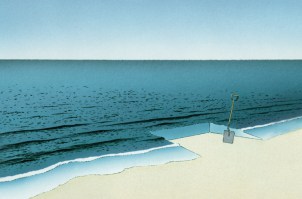
The U.S. has laid claim to 2.5 billion acres of coastal seas, but that vast area produces very little seafood for Americans. Therein lies a dilemma: should the U.S. cultivate giant offshore fish farms in its piece of the sea or keep taking most of the fish we eat from foreign waters?
Conservation magazine raises the following question, and goes a long way to answering it in their current issue:
NATIONS HAVE CARVED UP THE OCEAN. NOW WHAT?
…In the minds of most consumers, there is a clear dividing line between which fish are wild and which are farmed. But the truth is that this line is increasingly a blurry one.
What we are really talking about when we talk about farmed and wild fish is the degree to which those fish and the resources they require are under human control. Prior to 1950, almost all the seafood Americans ate was wild. But more importantly, before that date, the seafood we ate was nearly always ownerless—accessible to anyone around the world who could manage to get a boat to where the fish happened to be. Today, increasingly, the ownership of much of the fish we eat is at least partly predetermined, even before it leaves the water. In the course of the last half-century, the U.S. has in effect annexed 2.5 billion acres of water. How the world came to divvy up the sea, and how nations have used those newly nationalized resources, is the story of the modern ocean. How we and other nations develop them in the future will have huge ramifications for the future of the seas.
It is no small irony that the question of ocean ownership was first seriously debated as a result of events occurring in the waters off Greenland, the historical epicenter of the world’s most valuable farmed fish: Atlantic salmon. For millennia, wild Atlantic salmon from Europe and North America migrated from their home rivers and set out across the Atlantic, where they found in Greenland’s waters huge shoals of krill and capelin to prey upon. These same shoals of forage animals attracted pods of whales, which in turn attracted whalers. In 1613, two Dutch vessels in hot pursuit of whales were intercepted by a small English fleet. The British accused the Dutch captains of “trespassing” in waters claimed by the Crown, arrested their crews, and brought them back to London for trial. It was then that another kind of predator arrived on the scene: a lawyer from Holland named Hugo de Groot.
Hugo de Groot (or Hugo Grotius, as he is more commonly known) was a curious adventurer whose many exploits included surviving a shipwreck, governing Rotterdam, and escaping prison by mailing himself out in a shipping trunk. But by far his most memorable sleight of hand was convincing the world to fundamentally rethink how the ocean was owned. In 1609, Grotius published Mare Liberum or “The Free Seas,” in which he argued that no nation should have sovereignty over the oceans and that by opening up the seas to universal use, benefits would be garnered by all. And although Grotius would go on to lose the Greenland whaling petition in London, the concept of Mare Liberum was greatly popularized during the affair of the Dutch whalers; over the course of the next decades, it would be embraced by the great powers of Europe. It is in large part due to Grotius that from the 1700s all the way until the 1930s, nations would generally agree that the oceans beyond the distance a cannonball could fly would be available for common use—use that included, notably, fishing.
But World War II and its aftermath would finally change all that. The war was very much an ocean war, one where naval technology and an ocean-going vessel’s range dramatically improved. And with this new technology, the possibility of controlling the oceans came to be seen as a way to advance national ambitions. Fishing fleets, the inheritors of much of that WWII maritime technology, became pawns for expressing those territorial ambitions in the postwar era. Through government subsidies, fishing fleets were encouraged to go prospecting for new seafood sources in waters they might not have previously explored.
It was once again in the salmon-rich waters off Greenland that these issues would come to a head. On a series of exploratory fishing trips in 1951, Jørgen Nielsen, chief of Greenland Fisheries Research for the Danish government, deduced that a large percentage of Europe’s and North America’s wild Atlantic salmon converged annually in a relatively small portion of Greenland’s waters. Nielsen, as was his duty, placed this information into the hands of the Danish fishing fleet. What followed was an unregulated, species-decimating blitzkrieg in which Scandinavian fleets effectively stole salmon from the nations of the world. Their catches rose from 60 to more than 2600 metric tons within a decade. Catches were so phenomenal and seemingly limitless that a Danish captain named Ole Martensen bragged to a Copenhagen newspaper that he planned to go to Japan to learn the techniques of fishing on the publicly owned high seas. He promised to return with a new, 135-ton Japanese cutter equipped with the most modern Japanese gear. By 1970, thanks to people such as Captain Martensen, the wild salmon fishery of the North Atlantic became so public as to be out of control.
Not coincidentally, 1970 was the same year that privatized salmon aquaculture started in earnest. It all began when a Norwegian purse seiner captain named Sivert Grønvedt and his brother, Ove, started putting salmon juveniles into net pens hung in the sea off the island of Hitra. By 1971, their harvest would be 98 tons. Within a decade, the privately owned salmon farms of the Norwegian fjords would nearly replace the public salmon fishery.
Meanwhile, in the Pacific, the same Japanese high-seas fishermen who had schooled the Danish captain on how to really hammer wild salmon were causing similar damage in public fisheries around the world. Japan’s newly rebuilt fishing fleet began venturing into international waters. To the north, the Japanese moved into the Bering Sea with massive drift net operations that harvested hundreds of thousands of pounds of pink, chum, and sockeye salmon—many of which spawned in American rivers. To the south, Japanese fleets advanced into the upwelling of the Humboldt Current off Peru and Chile. Here, Japanese tuna vessels congregated, fishing international waters so hard that many local fishermen gave up entirely on hunting big fish. Instead, they turned to the tiny Peruvian anchoveta, a fish nobody seemed to want but which would later become the source of industrial feed for much of the world’s farmed salmon. Today the Peruvian anchoveta is the largest fishery on earth by tonnage, and most of it goes to feeding farmed fish.
Alongside this wild international race for fish, nations on the receiving end of the onslaught began objecting to what was perceived as outright piscatorial theft. In August 1952 Peru, Chile, and Ecuador collectively signed the Santiago Declaration, which established a 200–nautical mile exclusive economic zone for the cosigners of the treaty. The number 200 seems to hail from the Panama Declaration of 1939, in which the U.K. and the U.S. agreed to put in place a quarantine zone around South America in order to halt the resupplying of Axis ships in austral ports. Twenty years later, the United Nations would take up the issue in a series of meetings lasting into the 1980s, resulting in the eventual ratification of the United Nations Convention on the Law of the Sea (UNCLOS III). The U.S. would never sign UNCLOS III, but that didn’t stop it from unilaterally declaring a 200-mile EEZ in 1983. As the century entered its final quarter, nearly every nation came to own its marine resources in waters out to 200 nautical miles from shore. Hugo de Groot’s free seas were, increasingly, private property.
Now that the U.S. had exclusive rights to the ocean at its doorstep, maximizing the value of those waters was the next logical move. And there is perhaps no better place to see how that has been achieved than in the salmon grounds of Alaska. A little while back, I got a bird’s-eye view of this fishery while flying with R. J. Kopchak, a former Alaska commercial salmon fisherman, over Prince William Sound near the southeast Alaska town of Cordova…
Read the whole article here.
 Organikos
Reblogged this on "OUR WORLD".
Pingback: Everything is regulated and controlled by us humans in some way…. |