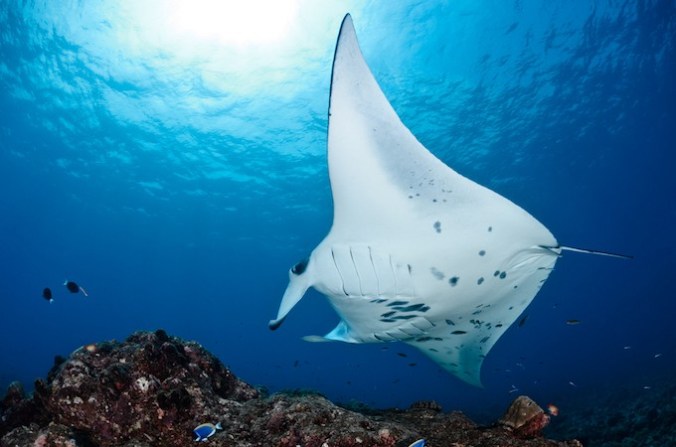
MANTA RAYS ARE WORTH MORE ALIVE THAN DEAD
The title may sound a bit obvious, but this article is anything but (thanks to Jason G. Goldman and Conservation magazine):
Manta and mobula rays, together the “mobulids” are among the most recognizable, charismatic fish in the world. They’re also particularly vulnerable, thanks primarily to the use of their gill plates in Traditional Chinese Medicine. That’s despite the fact that mobulid gill plates are not officially recognized by most practitioners of Traditional Chinese Medicine. There are so many nonsensical aspects to this story that it’s hard to know where to start.
In 2011, the international NGO WildAid compiled a report that identified Guangzhou, China as the “epicenter” of the trade in dried mobulid gill plates, which are called “Peng Yu Sai.” When they repeated their study two years later, in 2013, they discovered a threefold increase in mobulids that had been slaughtered for their gill plates, and a market value that had increased by 168 percent. Today, the trade in mobulid gill plates in Guangzhou is worth an estimated $30 million. A single dead manta ray is estimated to have a value of between $40 and $500 dollars, which means that in 2013 an estimated 147,000 mobulids were senselessly killed. All of that, despite the rays’ inclusion in Appendix II of CITES.
By contrast, WildAid estimates the annual global tourism value of manta and mobula rays at $140 million, and the estimated tourism value of just one single living manta ray is a whopping $1 million dollars. That means that a living manta ray is worth at least two thousand dead ones.
Together, that means that despite their optimal value alive, consumer demand for Peng Yu Sai has increased. Forgoing animal welfare and considering economics alone, it is obvious that manta and mobula rays are worth more for their tourism dollars than to have their gill plates harvested. So why has their consumer base grown so fast? It could be thanks to television and the Internet.
WildAid reports that as recently as 2010, the main way in which Peng Yu Sai was marketed was directly to consumers inside stores. By 2012, the product was featured on a mainstream Cantonese television show called Good Soup, Special Find. The show “featured a pharmacist from Guangzhou Provincial TCM Hospital demonstrating cooking techniques and recommending the soup for general good health and to aid in recovery from a variety of illnesses.” An Internet search using the Chinese website TaoBao (an online retailer estimated to be twice the size of eBay and Amazon combined) revealed at least thirty venders selling the gill plates. A Google research revealed more than a quarter million results, including recipes. “This progression from niche marketing to mainstream promotion,” says the report, “will likely result in continuing and more rapid expansion of demand for the product.”
And why shouldn’t it? Vendors promise consumers that regular ingestion of Peng Yu Sai can cure or aid recovery from diseases as wide ranging as cancer, acne, fever, chicken pox, and chronic cough. They claim it boosts the immune system, reduces toxins in the blood, lowers body temperature, and aids in blood circulation. Recently, vendors have begun recommendation the stuff to new mothers, to aid in lactation.
And here’s where the next completely baffling aspect of this story comes in. Not only are mobulid gill plates completely medically useless, but they might actually be toxic themselves.
The WildAid researchers retrieved samples of Peng Yu Sai on sale in Guangzhou and sent them to an independent laboratory to test for heavy metals. All samples contained arsenic, cadmium, mercury, and lead. The highest sampled levels for arsenic and cadmium were well beyond the permissible limits set by the Pharmacopoeia of China, the World Health Organization, the US Food and Drug Administration, and Singapore’s Health Sciences Authority.
Arsenic, in particular, was found at up to twenty times the permissible limit. Arsenic toxicity has been linked to skin, lung, and bladder cancer. Cadmium, which can severely impact the kidneys, was found at more than three times the permissible limit. Mercury only approached the permissible limit, but the researchers note that even small amounts can threaten the development of newborn infants, which makes the marketing of Peng Yu Sai to new mothers particularly troubling…
Read the whole article here.
 Organikos
This is a majestic and beautiful fish! Mobula Ray is as well amazing.
Agree! There is something ethereal in the way they swim.
Pingback: The Unexpected Manta Rays | Raxa Collective