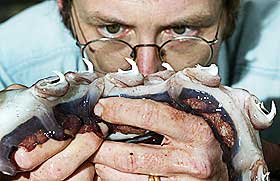
 We have posted a few times about awesome oceanic creatures, and their literary impacts, and lots of times about the heroes working to save whales in particular, so when this decade-old but still-fresh article on the giant squid we had missed came to our attention just now, we had to share it:
…Though oceans cover three-quarters of the Earth—the Pacific alone is bigger than all the continents put together—the underwater realm has remained largely invisible to human beings. For centuries, there was no way for scientists to peer into the depths, no telescope that could gaze into the abyss. (A pearl diver can venture down no more than a hundred feet.) Until the nineteenth century, most scientists assumed that the deepest parts of the ocean—where the temperature was frigid, the pressure intense, and the light minimal—contained no life.In 1872, the British government and the Royal Society launched the first major oceanic expedition, transforming a two-hundred-and-twenty-six-foot naval warship into a floating laboratory, equipped with microscopes and vats of pickling alcohol. Christened the H.M.S. Challenger, the ship, with five scientists, roamed the globe for three and a half years. The crew was constantly dredging the ocean floor for specimens, and the work was repetitive, and brutal; two men went insane, two others drowned, and another committed suicide. The scientists, however, were enthralled with their discoveries. They catalogued more than forty-seven hundred new species—proving, as C. Wyville Thomson, the chief scientist, later noted, that living beings “exist over the whole floor of the ocean.”
The voyage gave rise to the field of oceanography, but it also exposed the twin obstacles that would impede underwater exploration for generations: prohibitive costs and primitive technology. Even when scientists could finance expeditions, their equipment allowed them to study animals only after hauling them on deck—the equivalent of looking at a human corpse, then trying to imagine it alive.
In the nineteen-thirties, two wealthy Americans, Charles William Beebe and Otis Barton, used twelve thousand dollars of their own money to design a hollow steel ball with two quartz peepholes, which they called a “bathysphere,” named after the Greek word for “deep.” The vessel, which was four and a half feet in diameter, was tethered to a ship with a cable; if it snapped, the men inside would die at the bottom of the sea.
In 1934, near Bermuda, Beebe and Barton went down five hundred feet, then a thousand feet more, as greater and greater pressure pushed against the steel walls; they stopped at three thousand and twenty-eight feet. It was far deeper than anyone had ever gone. At one point, Beebe peered out, and spotted something that was at least twenty feet long. Later, in his autobiography, “Half Mile Down,” he wrote, “Whatever it was, it appeared and vanished so unexpectedly and showed so dimly that it was quite unidentifiable except as a large, living creature.”
In 1960, the United States Navy dispatched its own team of scientists to the bottom of the Mariana Trench, the deepest spot in the ocean floor, in the Western Pacific. (It is seven times as deep as the Grand Canyon.) The voyage was considered among oceanographers to be the equivalent of landing on the moon, but America was caught up in the Cold War, and, because such exploration had little military relevance, similar projects were soon abandoned.
According to one recent study, as much as ninety-five per cent of the oceans remains unexplored. It is believed that the seas contain as many as ten million species, of which fewer than half have been identified. By the nineteen-sixties, the giant squid had become, for oceanographers, an emblem of all that was still unknown about the seas…
Read the whole article here.
 Organikos