
These wooden tokens are handed out to shoppers who use SNAP benefits to purchase fresh produce at the Crossroads Farmers Market near Takoma Park, Md. Customers receive tokens worth twice the amount of money withdrawn from their SNAP benefits card — in other words, they get “double bucks.” Dan Charles/NPR
Thanks to the salt, a food-specialized segment on National Public Radio (USA), for this story of one country’s expanding definition and innovative rethinking of welfare, and of the various benefits associated with welfare:
The federal government is about to put $100 million behind a simple idea: doubling the value of SNAP benefits — what used to be called food stamps — when people use them to buy local fruits and vegetables.
This idea did not start on Capitol Hill. It began as a local innovation at a few farmers’ markets. But it proved remarkably popular and spread across the country.
“It’s so simple, but it has such profound effects both for SNAP recipients and for local farmers,” says Mike Appell, a vegetable farmer who sells his produce at a market in Tulsa, Okla.
The idea first surfaced in 2005 among workers at the New York City Department of Health and Mental Hygiene. They were starting a campaign to get people to eat more fresh produce.
“I think we were trying to confront the idea that healthy foods, [like] fresh fruits and vegetables, are not affordable,” says Candace Young, who was director of the department’s nutrition programming at the time. (Young now works for The Food Trust in Philadelphia.)
Young recalls that one of their workers pointed out that some SNAP recipients live near farmers markets “and we thought, how about we incentivize them to use their SNAP benefits at these farmers markets?”
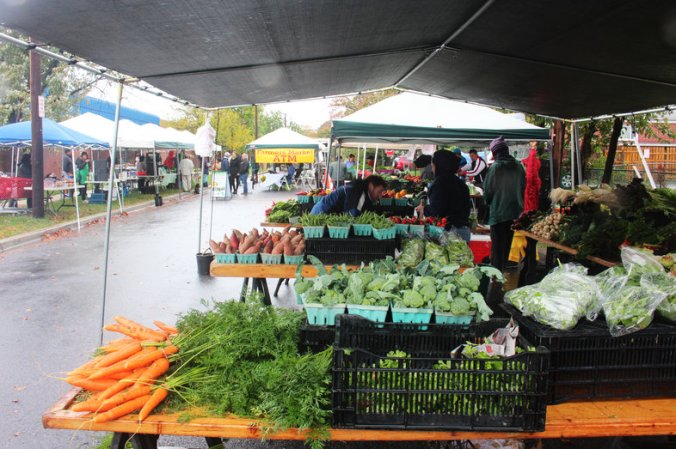
Crossroads Farmers Market is located in a heavily immigrant neighborhood on the boundary between Langley Park and Takoma Park, Md. Dan Charles/NPR
The city made a few thousand dollars available for the program. So at a few markets in the South Bronx and Harlem, when someone spent $10 of SNAP benefits, he then received an additional $4 in the form of coupons called HealthBucks, which could be used to buy more local produce.
This desire to make farmers markets more food-stamp friendly seems to have been floating in the air at that time. A farmers market in Lynn, Mass., used a $500 donation to do something similar the very next year.
Then, in 2007, the idea mutated into a form that really caught on.
It happened with the birth of the Crossroads Farmers Market, on the boundary that divides the towns of Langley Park and Takoma Park, Md. The area, just outside Washington, D.C., is home to many immigrants…
Read the whole story and/or listen to the podcast here.
 Organikos
Reblogged this on Zero Waste Millennial.