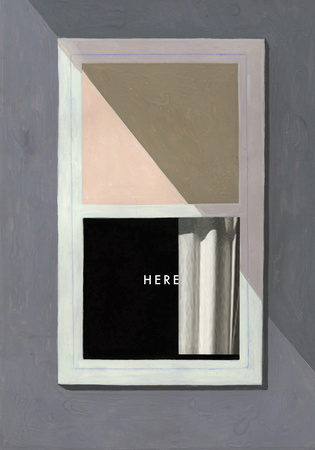
 We hope that the review of his book (thank you National Public Radio, USA), a hard cover tome that began as what we then called comic strips, brings one of the great graphic novelists of our time appropriate rewards worthy of his herculean efforts:
What is it about Richard McGuire’s Here? A simple-looking, black-and-white cartoon that first appeared in Raw magazine in 1989 — clocking in at a mere 36 panels — it’s maintained its hold on comic artists’ imaginations ever since. McGuire himself spent more than eight years creating this book-length version.
The words of his publisher, Pantheon, about the author make us want to explore this book and his earlier work, especially the toys:
Richard McGuire is a regular contributor to The New Yorker. His work has appeared in The New York Times, McSweeney’s, Le Monde, and Libération. He has written and directed for two omnibus feature films: Loulou et Autre Loups (Loulou and Other Wolves, 2003) and Peur(s) du Noir (Fear[s] of the Dark, 2007). He has also designed and manufactured his own line of toys, and he is the founder and bass player of the no-wave band Liquid Liquid. The six-page comic Here, which appeared in 1989 in Raw magazine, volume 2, number 1, was immediately recognized as a transformative work that would expand the possibilities of the comic medium. Its influence continues to be felt twenty-five years after its publication.
Back to the book review:
At first glance, it’s hard to see what the big deal is. Here — both in its original form and expanded into a full-color book — consists of a simple tactic that might even be called a gimmick: As events take place in a single large room, boxes appear showing what was happening in that spot at some other time in the past or future.
Perhaps a radio is playing in the main picture in 1943. In one inset window labeled “1986,” a woman cleans the floor. In another, labeled “1430,” a wolf walks by with a venison haunch.
Small stories play out a few pages at a time. As grim clouds change color in 3,000,500,000 B.C., an artist and his white-gowned muse settle down in a sunny meadow in 1873. As a man confronts his injured father in 2005, two couples play charades in 1964 and a small insect flies by in 2006.
Often, the intersections are mildly humorous. “This is our fort!” some children tell their mother in 1952. “You have to know the password to come in!” Meanwhile, on the other side of the page, it’s 1990 and a bridal party is posing for a photo. “Say cheese!” the photographer commands.
Some of the juxtapositions are beautiful: One spread combines five different time frames so the colors and lines form a web connecting people in the throes of different emotions (crying, embracing, texting).
In another, yellow- and blue-clad girls dance ecstatically in 1932, 1993 and 2014 as a woman plays piano in 1964. Other spreads don’t have any inset windows at all, as with a meditative landscape in 1,000,000 B.C.
And that’s about it — pretty straightforward, or so it seems. But the magic of Here is that somehow, alchemically, this sparse little exercise begins to yank on your emotions…
Read the whole review here.
 Organikos