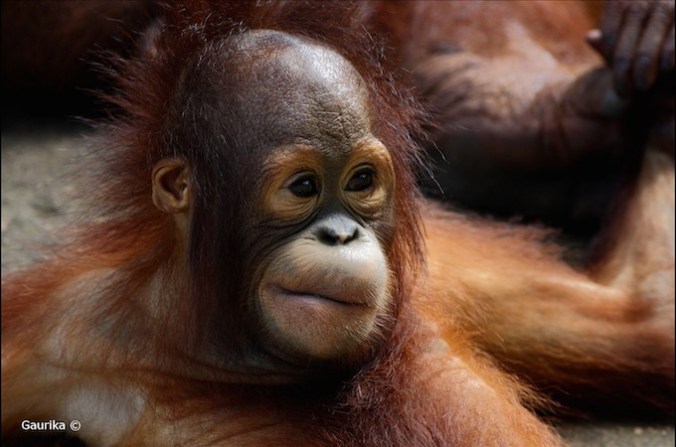
Logging generally does not come high on our priority list for inspirational stories, but we are nothing if not open to new ideas (thanks to Conservation for keeping up us apprised of encouraging surprises), especially when camera traps are involved to verify the facts:
ORANGUTANS MIGHT SURVIVE SUSTAINABLE LOGGING
Like for all of its great ape cousins, the rise of Homo sapiens has not been pleasant for the Bornean orangutan, Pongo pygmaeus. The endangered “red ape,” found only in Borneo, is threatened by the continuing loss of its forest home. Hectare after hectare of primary forest is being lost either to logging or to palm oil plantations.
Primatologists have historically thought of orangutans as primarily arboreal, only rarely descending to the forest floor. With the recent expansion of logging and its associated clearing of roads, some researchers have noted orangutans spending more time with their feet on the ground. The assumption is that the clearing of roads creates large open spaces in the forest canopy. Without the ability to move from branch to branch, orangutans are increasingly forced to come down to the ground and cross roads in order to travel. It’s further assumed that being forced to be more terrestrial would negatively impact orangutan populations. It is conceivable that being on the ground makes them more susceptible to persecution by humans or to predation. It’s also, theoretically, outside of their species-typical behaviors.
Or is it? New research published last week in the journalOryx suggests that orangutans may be more terrestrial than we thought, and have been all along. If true, that suggests that orangutans may be better able to thrive in the face of road construction and logging (if done sustainably) than has been assumed.
Simon Fraser University researcher Brent Loken, together with forestry researcher Chandradewana Boer from Indonesia’s Mulawarman University and Nunuk Kasyanto from an American NGO called Integrated Conservation, conducted a 2.5-year-long camera trap study in Wehea Forest, East Kalimantan, Indonesia, to test the assumption that orangutans prefer avoiding terrestriality when possible.
In all, they deployed 97 camera traps in three adjacent forest patches. One was mostly-undisturbed primary forest (within Wehea), one was a secondary forest in the process of recovering from logging which ended around 15 years prior to the study (also within Wehea), and a third was a patch of forest that was actively logged (“but not intensively”) just prior to data collection. In all, their camera trap array yielded information from 28,485 camera trap nights. Forty-four photos from the primary forest contained an orangutan, compared to 189 from the secondary forest, and 189 from the recently logged forest…
Read the whole summary here.
 Organikos