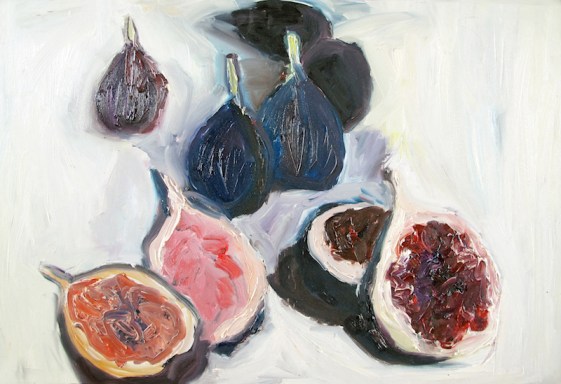
Path of Figs, 2012. Giulia Bianchi.
If you have not heard of Elena Ferrante before, you may want to start here, here, or here. But then come back here for this review. Thanks to the nplusone magazine website:
Those Like Us
On Elena Ferrante, by Dayna Tortorici,Issue 22: Conviction, Spring 2015
WHENEVER I HEAR someone speculate about the true identity of Elena Ferrante, the pseudonymous Italian novelist of international fame, a private joke unspools in my head. Who is she? the headlines ask. Don’t you know? I whisper. In my joke I’m sitting opposite someone important. The person promises not to tell, so I say:
She’s Lidia Neri.
She’s Pia Ciccione.
She’s Francesca Pelligrina. Domenica Augello.
Different names, every time, but the reaction is the same: a momentary light in the listener’s eyes that fades to bored disappointment. An Italian woman from Naples, whose name you wouldn’t know. Who did you expect?
One answer ends in o: the first name of a man. Whether to goad Ferrante out of privacy or because they think it’s true, the Italian newspaper L’Unità has accused the novelist Domenico Starnone of penning her books. If Starnone is behind Ferrante’s work, I would like to meet him. No man I know would write so well and not take credit for it.
Since the English-language publication of My Brilliant Friend, the first of the addictive Neapolitan novels that have inspired what publicists call “Ferrante fever” in American readers, Ferrante has caused a minor crisis in literary criticism. Her novels demand treatment commensurate to the work, but her anonymity has made it hard. The challenge reveals our habits. We’ve grown accustomed to finding the true meaning of books in the histories of their authors, in where they were born and how they grew up, in their credentials or refreshing lack thereof. Forget the intentional fallacy; ours is the age of the biographical fallacy. All six of Ferrante’s novels published in English to date (translated by the dexterous Ann Goldstein) are narrated in the first person, which invites this kind of reading. Surely work of such intimacy and length must be — as if all novels weren’t — true.
But there’s a greater obstacle still, which is that the novels are too good. Book reviewing is a game of outperforming the author, a small and practical agon. A young writer gets an assignment — a poorly written novel or a decent one; if she’s lucky, a fairly good one — and to make her name draws life from the host, like a gestating child, as if the goal of reviewing were not to explicate or describe a text but to produce another, better one altogether. Heaping praise is one thing, and praise for Ferrante is not hard to find: she is a master of our time, “the best contemporary novelist you have never heard of,” the “Italian Alice Munro.” But there is no outdoing Ferrante, and the best critical work on her novels has the humility of someone who knows it. “Writing about the Brilliant Friend books has been one of the hardest assignments I’ve ever done,” Jenny Turner wrote for Harper’s, and the admission is a relief. The most one can hope to do in writing about Ferrante is to ignore her. Fixating on her identity is one way to postpone reading — to kill time until the words come…
Read the whole review here.
 Organikos
Reblogged this on tinaness202.