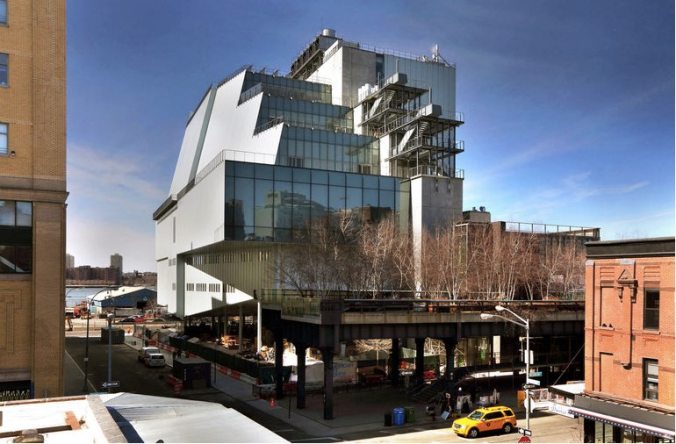
Whitney Museum of American Art. Photograph by Ed Lederman
We have a thing for public spaces, especially when they combine with community activism. We try to get firsthand experience, and when we have learned enough about such places, we share what we can here. Ditto for museum exhibits, special library exhibitions, and unusual library thingys. It is not every day we get to announce the opening, or re-opening, of one of the greatest museums in the world, right in the midst of such a public space:
THE NEW WHITNEY OPENS MAY 1, 2015 BUY ADVANCE TICKETS NOW
The reviews convince us that this will be worth the visit, and this particular wording puts it in perspective:
The Whitney Museum of American Art, long the odd duck among the Big Four of Manhattan art museums—a cohort that includes the mighty Metropolitan, the starry Modern, and the raffish Guggenheim—takes wing on May 1st, when it reopens in a new, vastly expanded headquarters downtown. The fledging owes a lot to the Italian architect Renzo Piano’s ingenious building, on Gansevoort Street, which features six floors of shapely galleries, four open-air terraces, spaces for performance and screening, a library and reading rooms, a restaurant, a café, and an over-all feeling of seductive amenity—a bar on the piazza-like ground floor bodes to be one of the toniest trysting spots in town. It is likely to win far more fans than the Whitney’s old home, Marcel Breuer’s brutalist “inverted ziggurat,” which opened in 1966, on Madison Avenue, and which it vacated six months ago and leased to the Met. Piano’s museum stands at the southern end of the High Line and hard by the Hudson River, in what remains of the tatterdemalion meatpacking district. It looms like a mother ship for both gallery-jammed Chelsea, to the north, and the puttering West Village, to the south. It is instantly a landmark on the cultural and social maps of the city—and on its poetic map, as a site to germinate memories.
But the most compelling change is a refurbished sense of mission for the eighty-four-year-old institution, signalled by the inaugural show, of six hundred and fifty works from the permanent collection, titled “America Is Hard to See.” The timing couldn’t be better for a detailed and vividly embodied engagement with the question of what has been meant by “American” modern art. The Whitney’s parochial mandate seemed a handicap during the past century of marching cosmopolitan styles, from Post-Impressionism and Cubism to minimalism and the myriad variants of conceptual art. Nationalism was then a bugaboo. But the restriction becomes a strength as, day after day in the headlines, one dream after another of a borderless world flames out. A national perspective offers a sturdy point of reference amid the redundancies of the nowhere-in-particular globalized culture.
Donna De Salvo, the Whitney’s chief curator since 2006, told me, “Our nimble spirit comes from our close working relationship with artists.” We stood outside her seventh-floor office, facing one of the building’s magnificent waterfront views. De Salvo is a veteran of museum work. She has been an adventurous curator at the Dia Art Foundation and, from 2000 to 2004, at London’s Tate Modern. Her comment jibed with my longtime sense of the Whitney as something like the big museum in a small city where all the people involved with art know one another. Partly, this reflects the history of the collection. Its beginnings were genteel-bohemian, with several hundred contemporary American works that belonged to the energetic heiress, sculptor, and saloniste Gertrude Vanderbilt Whitney. A passionate soul, Whitney, married to the businessman and horse breeder Harry Payne Whitney, chafed at the constraints of her caste. At the age of nineteen, she complained in her journal that “a man chooses the path that gives him the most thrill. That is what I want.” Art offered an escape from what she called “the big stagnation of riches,” as an avenue for both patronage and creativity; her own comic 1941 bronze of Peter Stuyvesant, in Stuyvesant Square, is a gem of public art.
In 1930, Whitney had offered her collection, which included many works by John Sloan, George Bellows, and other Ashcan School painters, and by the sterling modernists Marsden Hartley, Georgia O’Keeffe, and Stuart Davis, to the Metropolitan Museum. But the director, Edward Robinson, who was both averse to modern art and contemptuous of its American proponents, spurned it. Juliana Force, Whitney’s emissary, reported that he told her, “What will we do with them, dear lady? We have a cellar full of those things already.” She stormed out of his office without having conveyed Whitney’s offer of five million dollars for a new wing to house the works.
Whitney decided to open her own museum, on West Eighth Street, in 1931, and appointed Force its director. Since then, seven directors have overseen the growth of the collection, which now contains twenty-two thousand items, seventeen thousand of them works on paper. There are such touchstones as Alexander Calder’s “Circus” (1926-31), Arshile Gorky’s “The Artist and His Mother” (1926-36), Jasper Johns’s “Three Flags” (1958), Jay DeFeo’s massive relief “The Rose” (1958-66), Willem de Kooning’s “Door to the River” (1960), Nan Goldin’s slide-show installation “The Ballad of Sexual Dependency” (1979-96), and Mike Kelley’s caustic stuffed-animal array “More Love Hours Than Can Ever Be Repaid” (1987). But the collection lacks depth in most major artists, with the important exception of Edward Hopper. The Whitney has the largest concentration of his art anywhere, including such paintings as “Railroad Sunset” (1929) and the storefront epiphany “Early Sunday Morning” (1930), along with more than twenty-five hundred drawings. By ever more general agreement, Hopper is this country’s painter laureate, or, as De Salvo calls him, “our Picasso.”…
Read the whole review here.
 Organikos