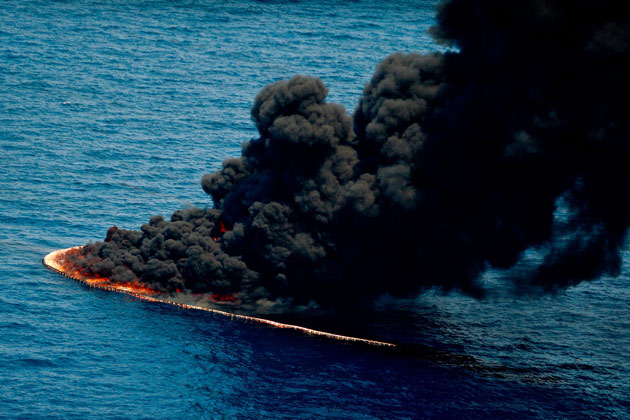
Phytol-based herders aren’t a universal remedy for oil spills, but in certain scenarios they could become the go-to mitigation strategy. PHOTO: Bloomberg
In May, an oil pipeline in Santa Barbara County burst, pouring some 21,000 gallons of oil into the Pacific Ocean. Despite clean-up crews’ efforts to contain it, the oil slick stretched along the coast for miles, serving as a glaring reminder that spill mitigation strategies are still lacking. When oil tankers crash and inevitably spill oil into the open seas, a go-to clean-up method is corralling the rapidly spreading oil and burning it. But in some places, like the ice-strewn Arctic ocean, physically corralling that oil with boats and boons is practically impossible. But here’s a plant-based, eco-friendly molecule that could be used to clean up the inevitable spills of the future.
Controlled burning of spills on the ocean’s surface is one way to quickly remove oil from the water, minimizing the effects of the rogue oil on the environment. In order to burn oil, slicks have to be relatively thick, but they tend to spread out in thin layers across the ocean’s surface. The high surface tension of water—the same property that allows bugs to walk on water—pulls the oil slick outward. Silicone-based products called chemical herders can be sprayed around the edges of the slick to lower the surface tension of the water, causing the oil slick to contract. The trouble is, after the oil is burned away, today’s silicone-based chemical herders remain in the water and their full effects on ocean habitats, and the animals that live there, are still unknown.
That fact prompted a team of researchers from the City College of New York and Tulane University to create an eco-friendly herder from a substance already abundant in the ocean: phytol, an organic compound released from Chlorophyll.
Read more on the mechanism and advantages of using phytol here.
 Organikos