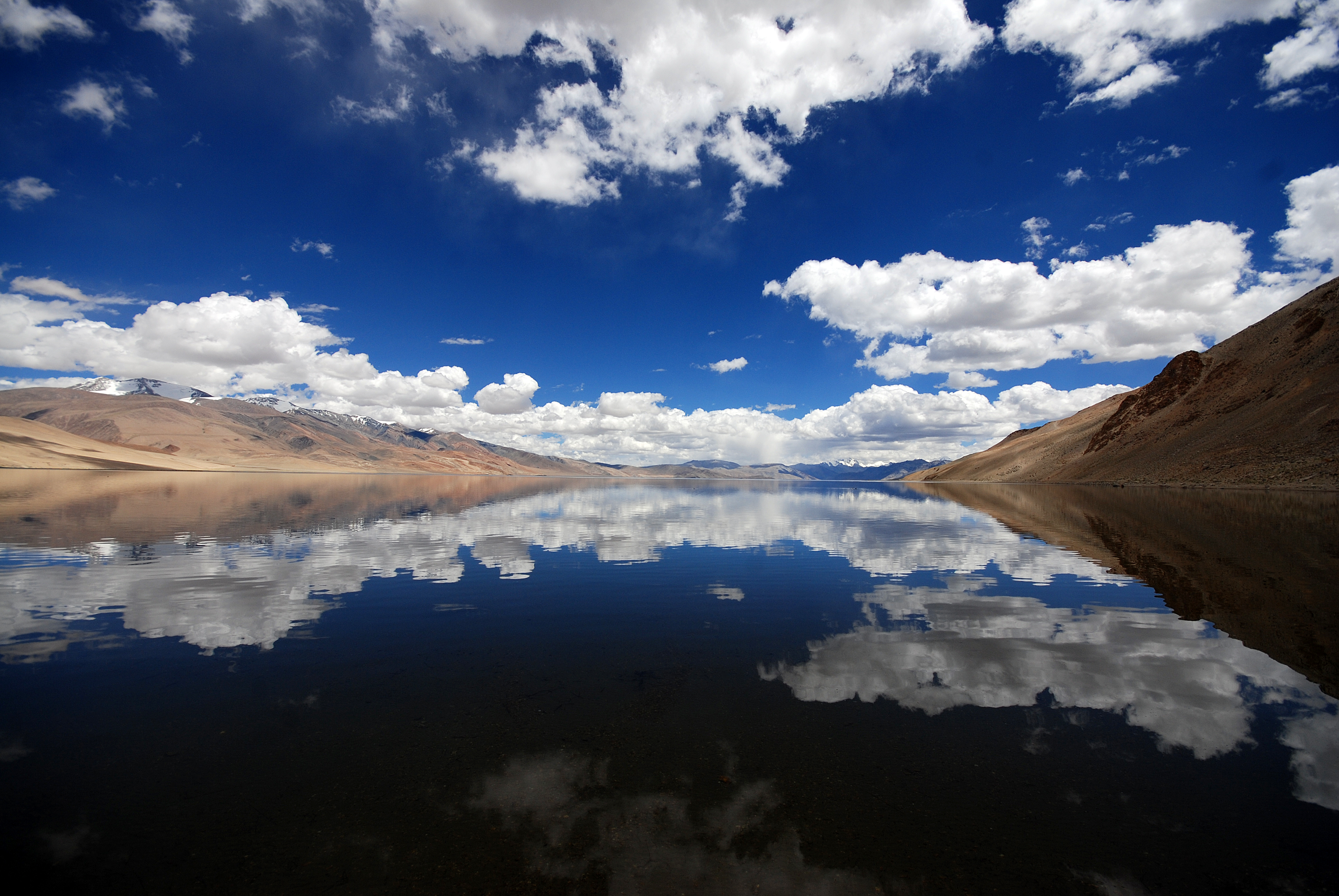
Ladakh’s beautiful mountains might be a paradise for tourists, but ask the locals who struggle to meet their basic water needs every year. PHOTO: Wikimedia Commons
Rain is scarce in the snow-peaked Himalayas of northern India, and summers bring dust storms that whip across craggy brown slopes and sun-chapped faces. Glaciers are the sole source of fresh water for the Buddhist farmers who make up more than 70% of the population in this rugged range between Pakistan and China. But rising temperatures have seen the icy snow retreat by dozens of feet each year. To find evidence of global warming, the farmers simply have to glance up from their fields and see the rising patches of brown where, once, all was white. Knowing no alternative, they pray harder for rain and snow. But Chewang Norphel had the answer: artificial glaciers.
Falling in the rain-shadow area of the Himalaya, Ladakh is a cold, mountainous desert. During winter, temperature drops below the -30°c mark. Annual average rainfall is 50 mm. Dearth of water is the most important problem. The only source is glacier water from the mountains. They melt in summer, releasing the little water that the people of Ladakh get.
Norphel’s idea started to develop when he retired in 1995; while he was in his yard, he noticed that water from a stream had frozen in the shade of a tree, but flowed freely everywhere else. He realized that the water had frozen because it flowed slower in the area under the tree, while elsewhere it flowed more quickly.
His idea is a prime example of appropriate technology, and here’s how he does it. He diverts water coming down the mountain into pipes or channels and brings the water to a shady section of a valley. There he builds a series of check dams out of stones to slow and hold back the water which then freezes at night. Because it is in the shade, the water will stay frozen until the weather warms up in March and then it is released into channels built to distribute the water just in time for the growing season. Here’s what Chewang had to say about it: “While there was such a shortage of water at the start of the cropping season, I saw a lot of water just running off and getting wasted in winter,” said Norphel. “And it is then that it occurred to me, why not try and make artificial glaciers in the vicinity of the villages so that local farmers get a real head start in the supply of water when they most need it.”
Norphel has created artificial glaciers, frozen pools of glacier run-off perched above the farmers’ fields, which thaw just in time for the start of growing season in April — two months before water from the distant natural glaciers is expected to arrive. The slanted pools melt into irrigation channels over the next six weeks, watering crops for villages of roughly 500 families and, as a bonus, recharging the valley’s natural springs. The biggest artificial glacier, 1000 ft long and 150 ft wide, with an average depth of 4ft, is situated near the village of Phuktsey. Having cost $2,000, it now provides water for the village of 700 people. Cement water reservoirs of similar capacities typically cost $34,000.
More on the Ice Man and his work here.
 Organikos
Reblogged this on Rashid's Blog.